
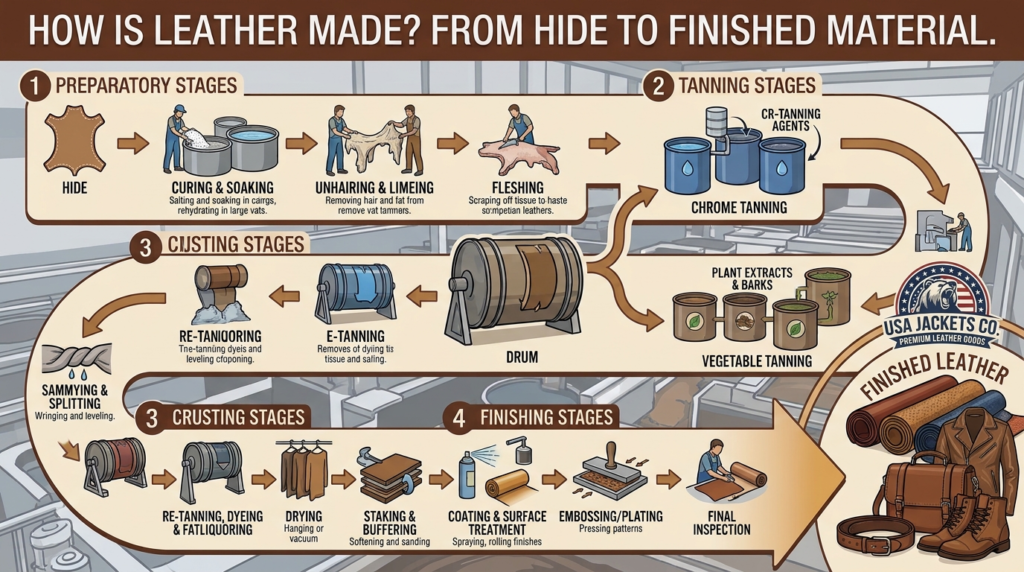
Leather is made by turning a perishable animal hide or skin into a stable material that can be cut, shaped and used for products such as jackets, shoes, bags and upholstery. The transformation involves preparation, tanning, post-tanning treatments, drying and finishing. When the leather is intended for a jacket, it then goes through a separate garment-making process: pattern cutting, panel matching, stitching, lining, hardware fitting and quality inspection.
The exact route varies by tannery, animal hide, tanning method and the required finish. Understanding the main stages helps buyers make sense of terms such as wet-blue, full-grain, split leather, aniline and fatliquoring—and helps explain why two genuine leather jackets can feel and look very different.
How Is Leather Made? The Short Answer
Leather is made by cleaning and preparing raw hides, stabilising their collagen structure through tanning, then adjusting their thickness, colour, softness and surface finish. The finished leather is inspected and supplied to manufacturers, who cut and assemble it into products. Tanning is the crucial conversion stage, but the later treatments determine much of the leather’s final character.
Stage 1: Collecting and Preserving the Raw Hide
Leather production begins with hides or skins obtained through supply chains that vary by region and industry. Many are co-products of the meat industry, although sourcing practices and traceability differ between suppliers. Once removed, a raw hide contains moisture and organic material that can deteriorate if it is not preserved and handled correctly.
Preservation may involve salting, chilling or another controlled method. The purpose is to slow bacterial activity and protect the material while it is transported to a tannery. Poor storage can cause damage before tanning even begins, so raw-material handling is an important part of quality control.
Hides and skins are not identical. A hide usually refers to the larger skin of a larger animal, such as cattle, while skins commonly refers to smaller animals such as sheep or goats. Their thickness, fibre structure, size and natural characteristics influence what kinds of leather can be produced.
Stage 2: Soaking and Beamhouse Preparation
At the tannery, preserved hides are soaked to rehydrate the fibres and remove salt, dirt and other soluble residues. They then pass through a group of wet-processing operations often called the beamhouse. These operations prepare the pelt for tanning.
Liming and unhairing
In many processes, alkaline treatment loosens hair and helps prepare the hide. Hair may be removed chemically, mechanically or through a combination of methods. The precise approach depends on the hide and the desired leather. Some products are intentionally made with hair left on, so hair removal is not universal.
Fleshing
Fleshing removes remaining flesh and fatty tissue from the underside. This helps create a cleaner, more even material for later operations.
Deliming and bating
After liming, the pelt is brought toward a more suitable pH. Enzymes may be used during bating to remove certain unwanted proteins and refine the feel and structure. The goal is to prepare the fibres for even tanning and the required finished characteristics.
Pickling
For many mineral tanning processes, pickling adjusts acidity and salt conditions before the tanning agent is introduced. It helps the tanning chemistry penetrate the pelt in a controlled way. Not every tanning method follows an identical sequence, so this is a general outline rather than a fixed recipe.
Stage 3: Splitting and Thickness Adjustment
Some hides are split into layers before tanning; others are split afterwards. A splitting machine separates the thicker hide horizontally. The upper layer contains the grain surface, while the lower layer is known as the split. This is one reason leather-grade terminology matters: full-grain, top-grain and split leather refer to different material characteristics and treatments.
Splitting and shaving help bring the material to a target thickness. A jacket needs leather that is consistent enough to cut and stitch, while retaining the body and flexibility required by the design. Too much variation between panels can make a garment feel uneven or cause difficulties during assembly.
For more detail about the hide layers, see our guides to full-grain leather, top-grain versus full-grain leather and split leather.
Stage 4: Tanning Turns the Pelt Into Leather
Tanning stabilises the hide’s collagen structure so it becomes leather rather than remaining a perishable raw skin. The tanning agent and process influence the material’s stability, feel and suitability for later treatments. Three broad approaches buyers may encounter are chrome tanning, vegetable tanning and chrome-free or combination systems.
Chrome tanning
Chrome tanning uses chromium(III) tanning salts, commonly basic chromium sulfate. For a focused explanation of this method, see our guide to chrome-tanned leather. It is widely used for many types of leather because controlled processing can produce flexible material with useful colour and finishing options. After chrome tanning, the intermediate material is commonly called wet-blue because of its blue-grey appearance. It still needs further processing before it becomes finished garment leather.
Vegetable tanning
Vegetable tanning uses tannins extracted from plant materials such as bark and leaves. It can produce leather with a firm, structured character and, depending on the finish, a noticeable patina as it ages. The method is often associated with belts, structured goods and traditional leatherwork, although suitable formulations can also be developed for garments.
Our guide to vegetable-tanned leather explains the method and its differences from chrome tanning.
Chrome-free and combination tanning
Some leather is made using other tanning agents or a combination of processes. A hide may receive one primary tannage and then be retanned with another agent to adjust its character. The terms used by suppliers can vary, so ask what the description means for the actual material rather than assuming that every “chrome-free” or “combination-tanned” product follows the same recipe.
For technical background on tannery operations and environmental controls, the International Finance Corporation and World Bank Group guidelines for tanning and leather finishing describe the main processing stages and management considerations.
Stage 5: Retanning, Dyeing and Fatliquoring
After the main tanning stage, the material is not necessarily ready for a jacket. Post-tanning operations refine the leather so it has the required colour, fullness, softness and handling properties. This is where the tannery adapts the material for a particular end use.
Retanning
Retanning is an additional treatment that can change the body, firmness, fullness and other characteristics of the leather. Different retanning agents can be selected to suit garments, footwear, upholstery or accessories. The recipe is one reason leather from the same animal species can be made to feel very different.
Dyeing
Dyeing adds colour to the leather. Colour may be introduced in a drum so it penetrates the material, or applied through surface finishing, depending on the intended appearance. Transparent dyes allow more of the natural grain to remain visible; pigmented finishes create a more uniform surface. The terms aniline and semi-aniline describe finishing approaches, not animal species or tanning methods.
Fatliquoring
Fatliquoring adds lubricating oils or fats to the leather fibres. This helps the material remain flexible after processing and drying. The amount and type of lubrication influence the hand feel, drape and softness. A jacket leather that is too dry or stiff may not move comfortably, while the right balance can make it easier to cut, sew and wear.
Stage 6: Drying, Softening and Milling
Once wet processing is complete, excess moisture is removed and the leather is dried under controlled conditions. Drying methods vary and can include hanging, frame drying or mechanical systems. The tannery needs to manage moisture removal so the material reaches the required condition without unwanted shrinkage or unevenness.
Dry leather may then be softened mechanically. Staking flexes the material to loosen its structure and improve suppleness. Milling or tumbling can soften the leather further and bring out a more natural grain character. Not every leather receives every treatment; the choice depends on the desired finish and end use.
Stage 7: Finishing Creates the Final Surface
Finishing is the set of treatments that give leather its final appearance and surface characteristics. Depending on the specification, it may include buffing, embossing, glazing, waxing, oiling, ironing, spraying or protective coatings. Some finishes are light and transparent; others create a more even or decorative surface.
For jacket buyers, the finish affects more than appearance. It can influence sheen, how natural grain shows, how easily marks are noticed and which care products are suitable. Aniline leather generally shows more natural surface character, semi-aniline adds a light protective finish, and pigmented leather usually has a more substantial colour layer. None of these terms alone proves that a jacket is better made.
Before buying, understand the difference between the tanning method and the finish. Our articles on aniline leather and semi-aniline leather explain why the surface treatment matters.
Stage 8: Inspection, Grading and Preparation for Garment Making
Finished leather is inspected for colour, thickness, surface condition, usable area and other specification requirements. Natural hide can contain marks, wrinkles, scars and differences in grain. These features are assessed against the grade and appearance the customer has ordered. A natural mark is not automatically a defect, but the material should still meet the agreed specification.
Leather is then measured and prepared for the manufacturer. The usable area and panel layout matter because a jacket contains several pieces that need to work together. A maker must consider grain direction, stretch, visible marks, colour matching and how each panel will sit when the garment is worn.
Stage 9: How Finished Leather Becomes a Jacket
Tanning produces the leather material; jacket manufacturing turns that material into clothing. These are related but separate stages. A well-tanned hide can still become a poor jacket if the pattern, cutting or stitching is careless.
- Design and pattern making: The maker develops the jacket shape, size range, panel layout, pockets, collar, cuffs and closure details.
- Leather selection: Panels are planned around the hide’s thickness, grain, colour and natural marks. The maker aims for a balanced appearance across the front, back and sleeves.
- Cutting: Pattern pieces are cut carefully to preserve the intended shape and make efficient use of the material. Poor cutting can create mismatched panels or distort the fit.
- Skiving and preparation: Where required, selected edges are thinned so seams and folded areas do not become unnecessarily bulky.
- Sewing and assembly: Panels are stitched together in the planned order. Stitch quality, seam allowance and reinforcement around stress points affect how the garment holds together.
- Lining and hardware: The lining, zippers, snaps, buttons, pocket bags and other components are fitted. Their quality and placement influence comfort and everyday use.
- Final inspection: The completed jacket is checked for measurements, symmetry, stitching, zipper operation, loose threads, lining issues and finish consistency.
When comparing made-to-order or custom garments, ask which parts can be adjusted and whether the maker can confirm measurements before production. The USA Jackets Co custom leather jackets page is a starting point for exploring design and material options.
What Makes Two Leather Jackets Feel Different?
Even when two jackets are made from genuine leather, they may differ because the material and manufacturing decisions are not the same. The most important factors include:
- Animal and hide selection: Cowhide, lambskin, goatskin and other hides have different natural structures and typical weights.
- Grain layer: Full-grain, top-grain and split leather describe different material choices and surface treatments.
- Tanning method: Chrome, vegetable, chrome-free and combination tanning use different chemistry and can suit different specifications.
- Thickness and temper: A jacket needs enough body for its design while allowing comfortable movement.
- Retanning and fatliquoring: These treatments help determine softness, fullness and flexibility.
- Dye and finish: Colour, sheen, natural grain visibility and surface protection depend on the finishing system.
- Pattern and construction: Fit, seam placement, lining and hardware quality are garment-making decisions, not tanning properties.
How Buyers Can Judge the Result
You do not need to be a leather technologist to make a more informed purchase. Ask for clear, specific information and assess the finished garment as a whole.
- Ask which animal hide is used and whether the seller can identify the leather grade.
- Find out the tanning method and the surface finish. Do not treat one term as a substitute for the other.
- Check the product photographs for natural grain, panel consistency and visible finish details.
- Compare the garment measurements with a jacket you already own, especially the chest, shoulders, sleeve and back length.
- Check how the jacket is lined and whether the sleeves and body allow the movement you need.
- Inspect stitching, zipper operation, pockets, cuffs and the attachment of hardware.
- Read the care, shipping, returns and custom-order terms before paying.
Our leather jacket buying guide and 15-point inspection checklist provide additional questions to use when comparing products.
Frequently Asked Questions
What is the first step in making leather?
The process starts with sourcing and preserving raw hides or skins. At the tannery, the material is soaked and cleaned before beamhouse preparation and tanning.
Which step actually turns hide into leather?
Tanning is the key conversion stage. It stabilises the hide’s collagen structure so the material becomes leather and can undergo further processing.
Is leather dyed before or after tanning?
In many processes, the main dyeing stage takes place after tanning, during post-tanning work. Some products may receive additional surface colour or finishing later.
What is wet-blue leather?
Wet-blue is chrome-tanned leather at an intermediate stage. It has not necessarily been fully dyed, dried, softened and finished for use in a jacket.
Does full-grain leather mean vegetable-tanned?
No. Full-grain describes the grain layer and its surface treatment; vegetable-tanned describes the tanning method. A leather can be full-grain and chrome-tanned, or full-grain and vegetable-tanned.
Does tanning determine how soft a jacket is?
It contributes, but softness also depends on the hide, thickness, retanning, fatliquoring, drying, mechanical softening and finish.
Is a jacket made in one step after the leather is finished?
No. The manufacturer still needs to develop patterns, select and cut panels, sew the garment, add lining and hardware, and inspect the finished jacket.
Can a natural mark on leather be a sign of poor quality?
Not automatically. Natural hides can show pores, wrinkles and small marks. The important questions are whether the material matches its stated grade and whether the mark is acceptable for the agreed product specification.
Final Takeaway
Leather is made through a sequence of controlled stages: preservation, cleaning, preparation, tanning, retanning, dyeing, fatliquoring, drying, softening and finishing. The finished hide is then inspected and transformed into a jacket through pattern cutting, sewing and assembly. For buyers, the useful lesson is to look beyond a single label. The hide, grain, tanning method, finish, thickness and garment construction all work together to determine how a leather jacket looks, feels and wears.
