
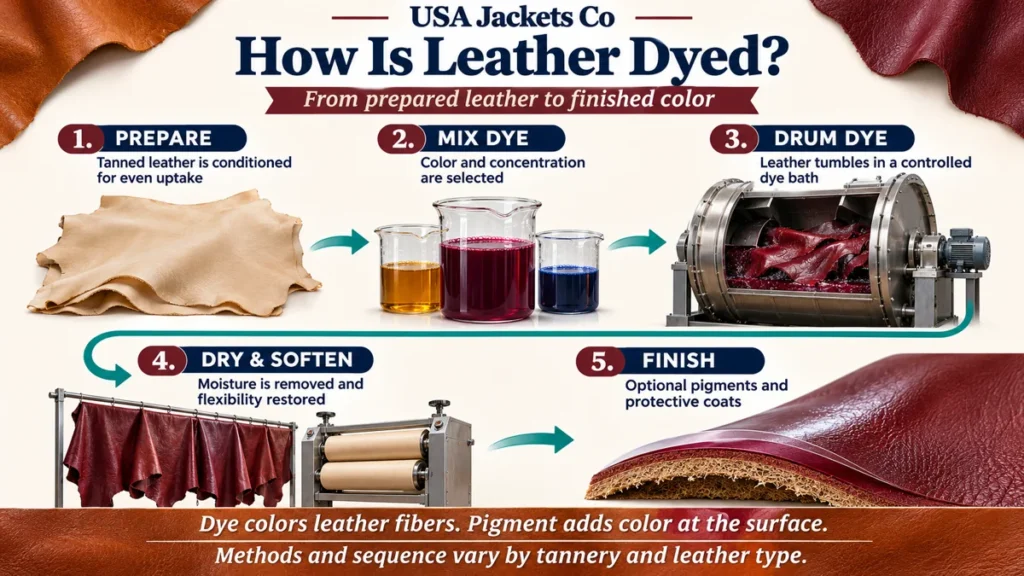
Leather colour is not simply painted onto every jacket in the same way. In most leather production, colour is introduced after tanning through a process chosen for the hide, the desired shade and the finish the maker wants to achieve. Some colourants penetrate into the leather fibres; others are applied closer to the surface as a pigmented coating. The final appearance is also influenced by drying, conditioning, surface finishing and quality control.
Understanding how leather is dyed helps explain why two jackets in a similar colour can look and age differently. It also helps buyers compare aniline, semi-aniline and pigmented finishes, understand why natural variation occurs, and know what questions to ask before ordering a particular shade.
First, understand the difference between tanning, dyeing and finishing
These three stages are related, but they do different jobs:
- Tanning stabilises raw hide so it becomes leather that can be used for clothing and other products.
- Dyeing adds colour to the leather. Depending on the method, colour may penetrate much of the material or mainly colour its surface.
- Finishing adjusts the final appearance and performance. It can add sheen, a matte look, a protective layer, texture or more consistent colour.
A jacket’s appearance is the result of all three stages, not dye alone. Two hides can receive a similar colour but look different because their grain, preparation and finishing treatments differ.
How leather is dyed: the main stages
1. Preparing the tanned leather
After tanning, leather is checked and prepared for further processing. Depending on the type of leather and the specification, it may be washed, adjusted for thickness, retanned, neutralised or treated to help it accept colour evenly. The exact sequence varies by tannery and by the finish being produced.
Preparation matters because leather is a natural material. Different areas of a hide can vary in density, fibre structure and absorbency. A careful process aims to reduce unwanted variation without removing the material’s natural character.
2. Adding colour in a drum
One common method is drum dyeing. Leather is placed in a rotating drum with a prepared dye solution. As the drum turns, the leather moves through the liquid and the colourant has time to enter the material. The formulation, temperature, duration and leather preparation all affect the result.
Drum dyeing can produce colour that penetrates beyond the visible surface. In some specifications, the hide is dyed through so the cut edge and reverse side show a related colour. In others, the colour is more concentrated near the face. Do not assume every dyed jacket is coloured completely through: ask the maker if that detail matters to you.
3. Applying colour to the surface
Colour can also be applied to the leather surface by spraying, rolling or other controlled finishing methods. This is useful when a maker wants a more even shade, a particular visual effect or a layer of pigment. Surface colour is not automatically a sign of poor quality; it is a finishing choice with its own advantages and trade-offs.
A pigmented finish can make colour more uniform and help disguise small differences in the hide. The trade-off is that a heavier coating can make the natural grain less visible and may create a more consistent, less transparent appearance than an aniline finish.
4. Drying, softening and finishing
After colouring, leather is dried under controlled conditions. It may then be softened or mechanically worked to achieve the required handle and flexibility. A final finish can add a protective layer, change the sheen, deepen the colour or create a matte, glossy, waxed or vintage effect.
The finished leather is checked for shade consistency, surface defects and other specification points. A good process aims for an attractive result while preserving the flexibility needed for a wearable jacket.
Dye versus pigment: what is the difference?
The words are sometimes used loosely in product descriptions, but they refer to different approaches.
| Colour approach | How it works | What a buyer may notice |
|---|---|---|
| Dye | Colourant enters the leather fibres to varying depths. | The natural grain can remain visible, especially with transparent finishes. |
| Pigment finish | Fine colour particles are carried in a surface coating. | The shade can look more even and opaque; natural marks may be less visible. |
| Combination finish | Leather is dyed and then receives a lighter or heavier surface finish. | A balance of colour depth, consistency and surface protection is possible. |
Neither method tells the whole quality story. Leather selection, preparation, application, finishing, stitching and construction all matter. A well-made pigmented jacket can be a sensible choice for someone who prefers consistent colour and straightforward everyday styling. A buyer who values visible natural grain may prefer a more transparent finish.
Aniline, semi-aniline and pigmented leather colours
Aniline leather
Aniline leather is coloured with transparent dyes and has little or no opaque pigment covering the surface. Its natural grain and individual markings remain easy to see. That gives it depth and character, but it also means differences between sections of a hide are more apparent. Aniline leather can show marks and colour changes more readily, so it generally suits buyers who appreciate a natural-looking surface and are comfortable with more attentive care.
Semi-aniline leather
Semi-aniline leather is dyed and receives a light protective pigment or finish. The natural grain can still be visible, while the surface gains a more controlled appearance. The precise balance differs between makers, so the term alone does not guarantee a particular level of protection or feel.
Pigmented leather
Pigmented leather has a more substantial colour coating. It usually offers a more uniform shade and can conceal minor surface variation. The coating may make the grain look less pronounced, depending on its thickness and texture. For buyers who want a consistent black, brown or fashion colour, this can be a practical finish.
For a deeper look at the leather options available for custom work, see the USA Jackets Co custom leather jackets page, which outlines choices such as aniline, semi-aniline, suede, nubuck and different surface finishes.
Why the same colour can look different on two leather jackets
A shade name such as tan, cognac, chocolate brown or burgundy is a useful starting point, not an exact colour formula. Several factors can change the result:
- The hide itself: Natural differences in grain, thickness and absorbency can affect how colour is taken up.
- Leather type: Lambskin, cowhide, goatskin, suede and nubuck have different surfaces and fibre structures.
- Colour formulation: A dye mixture and a pigment coating can produce different depth and opacity even when the target shade is similar.
- Finishing: Matte, glossy, waxed or protective topcoats can change how light reflects from the colour.
- Lighting and screens: Warm indoor light, daylight and phone displays can make the same sample appear different.
- Production batches: Small shade differences can occur between separate batches of natural material.
This is why a product photograph should be treated as a guide rather than a guarantee of an exact shade. If colour matching is important, ask whether a physical swatch or a confirmation photograph under neutral lighting is available before production.
Does leather dye rub off or fade?
Colour transfer and fading are different issues. Dye transfer can occur when loose colourant or finishing residue remains on the surface, particularly if leather has not been properly fixed, finished or allowed to dry. Friction, moisture and contact with pale clothing can make transfer more noticeable. Fading is a gradual loss or change of colour caused by factors such as light exposure, abrasion, cleaning and the chemistry of the colour and finish.
No leather finish should be assumed to be completely immune to these effects. A well-controlled dyeing and finishing process can improve colour stability, but the result depends on the complete specification. When buying, ask how the leather is finished and whether the maker recommends any precautions for the first few wears.
New dark leather can be worth pairing with darker clothing until you know how it behaves. If you notice unusual transfer, stop wearing it against pale fabrics and contact the seller for care advice rather than applying household chemicals or another coating yourself.
How to choose a leather jacket colour and finish
Start with how you want the jacket to look after regular use, not only how it appears in a product photo.
- For a clean, uniform appearance: Look at evenly finished black, dark brown or other pigmented colours.
- For visible natural grain: Ask about aniline or lightly finished leather and understand that markings may vary.
- For a balance: Semi-aniline may offer a middle ground between natural appearance and a more controlled surface.
- For a soft, textured look: Suede and nubuck use different surface treatments and need care suited to their nap.
- For a distinctive shade: Ask whether the maker can produce a custom colour and how closely it can be matched to a reference.
USA Jackets Co offers products with colour options that can include black, blue, brown, grey and custom colour. For example, the Justin Genuine Leather Jacket lists several colour choices. The exact options depend on the product, so check the current selection and ask for clarification before ordering a shade that is not shown.
Questions to ask before ordering a coloured leather jacket
- Is the leather drum-dyed, surface-coloured or treated with a combination of methods?
- Is the colour dyed through, or is it mainly on the grain side?
- What finish is used: aniline, semi-aniline, pigmented, waxed or another finish?
- Will natural marks and shade variation remain visible?
- Can you provide a swatch or a recent photograph of the actual leather?
- Are there any first-wear precautions to reduce the risk of colour transfer?
- What cleaning method is recommended for this particular finish?
Clear answers help you compare like with like. A product described only by colour and leather type leaves important details unanswered.
How to care for dyed leather
Follow the care instructions supplied for the jacket because a smooth pigmented finish, aniline leather and suede do not all respond to the same products. As a general starting point:
- Keep the jacket away from prolonged direct sunlight and intense heat when storing it.
- If it becomes wet, blot surface moisture gently and allow it to dry naturally away from radiators and hairdryers.
- Use only a cleaner or conditioner confirmed as suitable for the leather and finish.
- Test any approved product on a hidden area first and allow it to dry before treating the rest.
- Do not use household cleaners, alcohol, bleach, or ordinary shoe polish unless the leather-care professional specifically confirms compatibility.
- For significant stains, colour loss or damage, consult a leather specialist rather than attempting a full re-dye at home.
For colour-specific options and made-to-order details, visit Custom Leather Jackets. USA Jackets Co also explains its colour-choice approach in its Why Buy From Us information.
Frequently asked questions
Is leather dyed before or after it is made into a jacket?
Leather is generally coloured during leather processing, before it is cut and sewn into a jacket. The finished hide may also receive surface colour or a protective finish before garment production.
Is dyed leather real leather?
Yes. Dyeing is a normal way to colour genuine leather. The important questions are what material is being used, how it is coloured and what finish is applied.
Is aniline leather dyed?
Yes. Aniline leather is coloured with transparent dyes and has little or no opaque pigment coating, allowing much of the natural grain to remain visible.
Does pigment mean fake leather?
No. Pigment is a surface-colouring method that can be used on genuine leather. It describes the finish, not whether the underlying material is real leather.
Can a leather jacket be dyed a different colour later?
Sometimes, but results depend on the original leather, existing finish, colour and condition. A professional should assess the jacket first. Recolouring can change the texture or feel and may not produce an even result.
Why does my leather jacket look slightly different from the website photo?
Natural hide variation, lighting, display settings and production batches can all affect perceived colour. Ask for a swatch or a current sample photograph if an exact shade is important.
Final takeaway
Leather colour is created through a combination of dyeing and finishing choices. Drum dyeing can introduce colour into the material, while pigment coatings create a more uniform surface; aniline, semi-aniline and pigmented finishes each offer a different balance of natural grain, consistency and care requirements. When choosing a jacket, look beyond the colour name and ask how the leather is coloured, what finish it receives and how that finish should be maintained. Those details give you a much clearer idea of what you are buying.
