
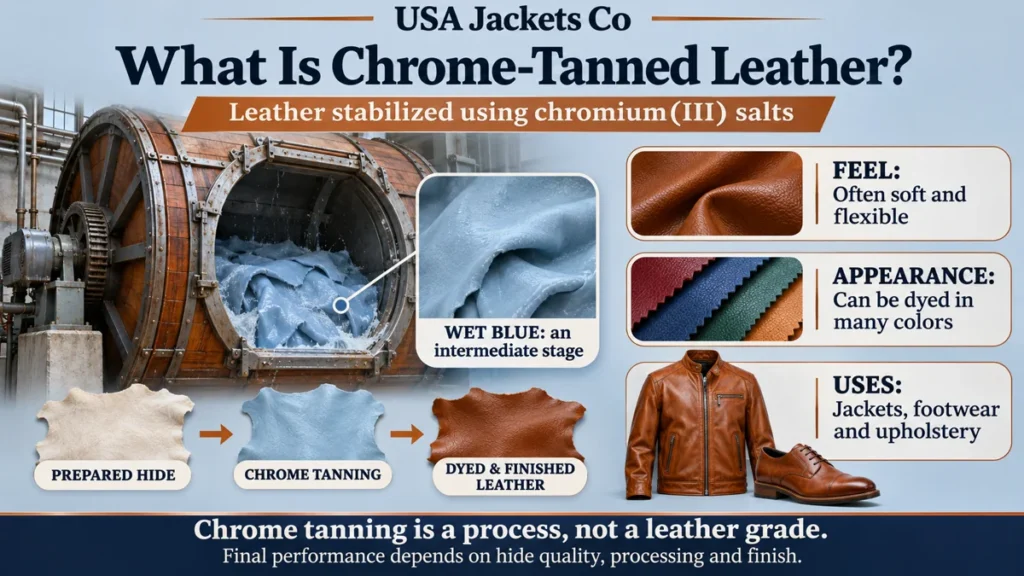
Chrome-tanned leather is genuine animal hide that has been stabilised using chromium(III) tanning salts, commonly basic chromium sulfate. The tanning agents interact with the hide’s collagen structure, making it less prone to decomposition and suitable for use in garments, footwear, upholstery and other leather goods. Chrome tanning is widely used because it can produce leather with a supple hand, useful flexibility and consistent results when the process is properly controlled.
For a jacket buyer, the key point is that chrome tanning describes how the hide is tanned. It does not tell you whether the leather is cowhide, lambskin or goatskin, whether it is full-grain or top-grain, or whether the surface is aniline or pigmented. Those are separate specifications that influence the finished jacket.
What Is Chrome-Tanned Leather?
Chrome-tanned leather is leather made using chromium(III) compounds as the main tanning agent. During tanning, these compounds penetrate the prepared hide and help stabilise its collagen fibres. The result is a material that can be dried, softened, dyed and finished without behaving like an untreated raw skin.
The chromium used for conventional chrome tanning is trivalent chromium, written as Cr(III). It is important not to confuse this with hexavalent chromium, Cr(VI), which is a different chemical form. Chromium(VI) is not the tanning agent intended in a controlled chrome-tanning process. Responsible chemical management, testing and storage practices matter because leather production involves several wet-processing and finishing stages, not just the tanning bath.
Chrome-tanned leather is still real leather. It is not synthetic leather, bonded leather or a plastic coating. The word “chrome” refers to the tanning chemistry, not to the visible surface or colour of the finished product.
How Is Chrome-Tanned Leather Made?
The exact recipe varies by tannery, hide type and the specification being produced. For a broader look at the full journey from raw hide to a finished garment, see our guide to how leather is made from hide to finished material. A typical route includes the following stages:
- Hide preparation: Raw hides or skins are preserved and then soaked to remove salt, dirt and soluble residues. Hair, flesh and unwanted tissue are removed during beamhouse operations. The aim is to prepare a clean, evenly treated pelt.
- Deliming, bating and pickling: The hide is brought from the alkaline conditions used in earlier preparation to a condition suitable for tanning. Enzyme treatment may be used to refine the fibre structure. Pickling adjusts the acidity and salt conditions so the tanning agent can penetrate in a controlled way.
- Chrome tanning: Prepared hides are placed in drums or other tanning equipment with chromium(III) tanning salts. Movement helps the tanning liquor reach the hide evenly. Time, temperature, pH and chemical concentration are controlled for the required leather specification.
- Fixation and basification: The tannery adjusts the conditions so more of the tanning agent becomes fixed within the hide structure. The aim is an even, stable result rather than simply exposing the pelt to a chemical bath.
- Draining and assessment: After tanning, the leather is drained and checked. Chrome-tanned material at this intermediate stage is commonly called wet-blue, a name taken from its characteristic blue-grey appearance before final dyeing and finishing.
- Post-tanning and finishing: The wet-blue leather may be neutralised, retanned, dyed, fatliquored, dried, softened and surface-finished. These later operations have a major influence on the final hand feel, colour, grain appearance and performance.
Chrome tanning is often faster than traditional pit vegetable tanning, but there is no single production time that applies to every tannery. Hide thickness, equipment, chemical formulation, the target article and the amount of post-tanning work all affect the schedule.
What Does Wet-Blue Mean?
Wet-blue is an intermediate material, not normally the finished leather a customer sees on a jacket. It has been chrome-tanned but still contains moisture and may need further processing before it is ready for garment manufacture. The tannery can split or shave it to a target thickness, retan it, add dyes and oils, dry it, soften it and apply the required surface finish.
This distinction matters because two hides can both be described as chrome-tanned yet feel quite different when finished. A soft garment leather and a firmer upholstery leather may begin with similar tanning chemistry but receive different retanning, lubrication, thickness adjustment and finishing treatments.
How Does Chrome Tanning Affect the Finished Leather?
Softness and flexibility
Chrome tanning is commonly selected for leather that needs to remain flexible. The final softness is not created by the tanning agent alone: the hide species, thickness, retanning recipe, oils, drying and mechanical softening all contribute. A chrome-tanned jacket can therefore be soft and fluid, but the label does not guarantee a particular hand feel.
Colour options
Chrome-tanned leather can be dyed and finished in a broad range of shades. The final colour may be added through drum dyeing, surface pigmentation or a combination of treatments. A transparent aniline finish reveals more of the natural grain, while a more substantial pigmented finish creates a more even surface. The finish, not the tanning method by itself, determines much of the visible appearance.
Garment drape
When the leather is correctly selected and finished for clothing, it can bend and move comfortably around the shoulders, elbows and torso. Thickness and temper still need to suit the jacket pattern. A heavy, firm hide can feel restrictive in a close-fitting fashion jacket even if it has been chrome-tanned.
Heat and moisture behaviour
Tanning improves the stability of raw hide, but chrome-tanned leather should not be treated as waterproof. Water resistance depends on the hide, finishing system, seams and garment construction. A jacket may tolerate light contact with moisture without being designed for prolonged rain. Follow the maker’s care instructions rather than assuming that chrome tanning makes a garment weatherproof.
Benefits and Limitations of Chrome-Tanned Leather
| Potential advantages | What buyers should still check |
|---|---|
| Can produce supple, flexible leather suited to garments. | Actual softness depends on hide, thickness, retanning and finishing. |
| Works with a wide range of colours and surface finishes. | Ask whether the surface is aniline, semi-aniline, pigmented, waxed or otherwise treated. |
| Can provide consistent results in controlled production. | Consistency still depends on hide selection, process control and inspection. |
| Often has a shorter tanning cycle than traditional pit vegetable tanning. | Overall production time includes preparation, post-tanning, drying and finishing. |
| Suitable for many types of clothing and leather goods. | The leather weight and temper must match the intended product. |
There are also process-management considerations. Chromium-containing tanning liquors and wastewater need appropriate segregation, recovery or treatment. Tannery environmental performance depends on the facility’s full operations, including water use, chemical handling, solid-waste management and finishing processes. The International Finance Corporation’s Environmental, Health, and Safety Guidelines for Tanning and Leather Finishing discuss wastewater streams, chromium management and process controls. The existence of chrome tanning alone does not tell a buyer how responsibly a particular tannery operates.
Chrome-Tanned vs Vegetable-Tanned Leather
Both methods make genuine leather, but they use different tanning agents and often serve different design goals. Chrome tanning uses chromium(III) salts; vegetable tanning uses plant-derived tannins. Neither method automatically makes a jacket high quality. The hide, finished specification and construction remain important.
| Comparison | Chrome-tanned | Vegetable-tanned |
|---|---|---|
| Main tanning agent | Chromium(III) tanning salts | Plant-derived tannin extracts |
| Common hand feel | Often supple and pliable | Often firmer or more structured, although recipes vary |
| Typical use | Garments, footwear, upholstery and many leather goods | Belts, structured goods, saddlery and selected garments |
| Ageing | Depends strongly on dye and surface finish | Some natural finishes develop a pronounced patina |
| Buyer priority | Flexibility, colour options and garment suitability | Structure, traditional character and patina potential |
These are broad tendencies, not fixed rules. A softened vegetable-tanned leather can be flexible, and a chrome-tanned leather can be firm. For a closer comparison, read our guide to vegetable-tanned leather.
Is Chrome-Tanned Leather Safe?
It is misleading to label every chrome-tanned leather item either completely harmless or automatically dangerous. Conventional chrome tanning uses chromium(III), and the safety and environmental profile depends on the chemicals used, how the process is controlled, the treatment of wastewater and waste, and the quality checks applied to the finished material.
Chromium(VI) is chemically different from chromium(III). It is not the tanning agent that a controlled chrome-tanning process is intended to use. Manufacturers and suppliers should manage chemicals appropriately and comply with relevant market requirements. If a buyer needs assurance for a particular product, the useful questions are whether the supplier can provide relevant test information, restricted-substance compliance details or traceability—not whether the product description simply says “chrome-tanned.”
Is Chrome-Tanned Leather a Good Choice for a Leather Jacket?
It can be. Many jacket designs benefit from leather that bends easily, takes colour well and can be finished to achieve a chosen appearance. Chrome-tanned garment leather may suit a bomber, racer, biker-inspired jacket or other everyday style, provided the hide weight and finish are appropriate for the design.
However, do not choose a jacket on tannage alone. Check the hide source, grain layer, thickness, lining, seam construction, zipper quality, fit and care instructions. A well-cut jacket in a suitable leather is more useful than a garment with an impressive material label but poor proportions or weak construction.
If you are exploring made-to-order options, the USA Jackets Co custom leather jackets page explains the range of leather and finish choices available. Confirm the exact hide, finish and garment specification with the seller before ordering.
What to Ask Before Buying Chrome-Tanned Leather
- Which hide is used? Ask whether the jacket is made from cowhide, lambskin, goatskin or another material. Species affects grain, weight and feel.
- What is the grain layer? Find out whether the leather is full-grain, top-grain or split. These terms describe a different part of the specification from tanning.
- What is the finished thickness? A garment needs a balance of body and flexibility. Ask for a swatch or product-specific details if the weight matters.
- What finish is applied? Aniline, semi-aniline, pigmented, waxed and distressed finishes have different appearances and care requirements.
- Is the leather intended for garments? Leather made for upholstery or heavy footwear may not drape comfortably in a lightweight jacket.
- What testing or compliance information is available? If chemical compliance is important, ask for relevant documentation rather than accepting vague assurances.
- How should it be cared for? Request instructions for cleaning, conditioning, moisture and storage that match the exact finish.
- How is the jacket constructed? Inspect stitching, lining, zips, pocket reinforcement, panel matching and the way the jacket fits when zipped.
Our 15-point leather jacket checklist covers the wider garment checks to make before paying.
How to Care for a Chrome-Tanned Leather Jacket
Care depends more on the finished surface than on the tanning method alone. Remove dust with a soft dry cloth. If the jacket gets wet, blot away surface moisture and let it dry naturally on a broad hanger in a ventilated place, away from radiators and direct sunlight. Do not machine-wash, tumble-dry or use household solvents and detergents.
Use a leather cleaner or conditioner only if the manufacturer recommends one for that finish. Test any approved product on a hidden area first. Too much conditioner can darken leather or leave residue, while an unsuitable cleaner can affect colour or sheen. For deep stains, colour transfer or damaged panels, consult a leather-care specialist.
Frequently Asked Questions
Is chrome-tanned leather real leather?
Yes. It is genuine animal hide stabilised using chromium(III) tanning salts. The term describes the tanning process, not a synthetic material.
Is chrome-tanned leather better than vegetable-tanned leather?
Neither is universally better. Chrome tanning is often chosen for flexible garment leather and varied finishes. Vegetable tanning is often chosen for structured leather and patina potential. Choose according to the product and the finished specification.
Does chrome-tanned leather contain chromium(VI)?
Chrome tanning is based on chromium(III), not chromium(VI). The two forms are different. If you need product-specific assurance, ask the supplier for relevant testing or compliance information.
Is chrome-tanned leather waterproof?
No. Some finishes improve resistance to moisture, but chrome tanning alone does not make leather waterproof. Seams, zips and garment construction also affect how a jacket handles rain.
Why is chrome-tanned leather often used for jackets?
It can be processed into supple, flexible garment leather and accepts a wide range of colours and finishes. The finished result still depends on hide selection, thickness, retanning and construction.
What is wet-blue leather?
Wet-blue is chrome-tanned leather at an intermediate, moisture-containing stage before final post-tanning and finishing. It is not necessarily ready to be cut into a jacket.
Can chrome-tanned leather develop a patina?
It can change with wear, light and handling, but the effect depends on the dye and finish. A natural or lightly finished surface usually shows ageing differently from a heavily pigmented coating.
Final Takeaway
Chrome-tanned leather is genuine leather made using chromium(III) tanning salts. It is widely used because it can be made supple, flexible and available in many colours and finishes—qualities that can suit leather jackets. But the tanning method is only one part of the specification. Before buying, check the hide, grain, thickness, finish, construction, care instructions and the supplier’s process information. Those details tell you far more about whether a particular jacket is right for you.
