
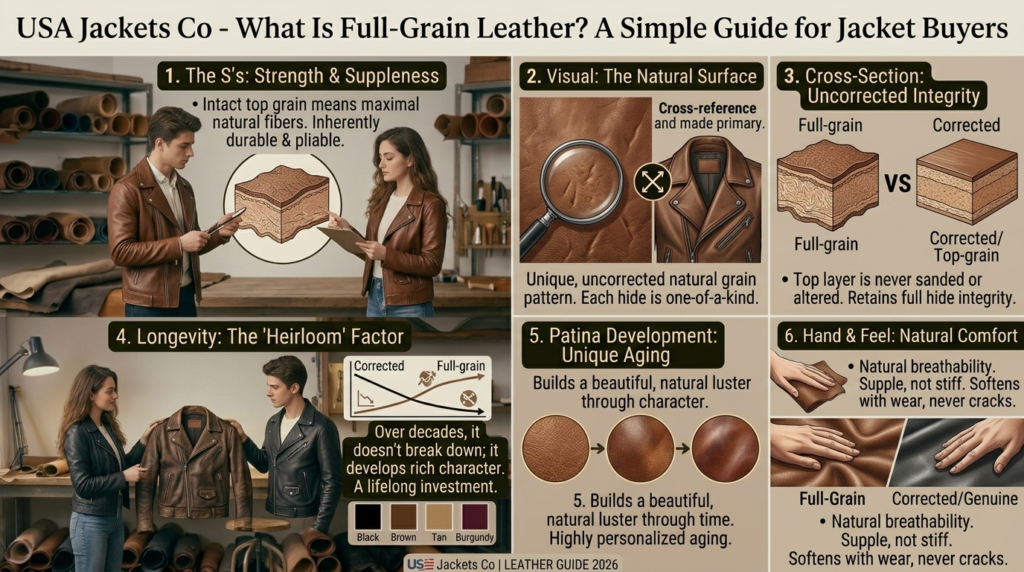
Full-grain leather is a term you will often see on premium leather jackets, but what does it actually mean? In simple terms, full-grain leather uses the hide’s outer grain surface without sanding or buffing away that grain to create a more uniform look. The natural texture and some marks from the animal’s life remain visible, which is part of its appeal.
That does not mean every full-grain jacket is automatically excellent. Hide selection, tanning, finishing, thickness, stitching, lining, fit, and care all influence the finished garment. This guide explains what full-grain leather is, how it differs from other leather grades, and what jacket buyers should check before paying extra for it.
What is full-grain leather?
Leather is made by processing animal hide so it becomes stable and usable rather than decomposing. In full-grain leather, the outer grain surface is retained instead of being sanded or buffed to remove its natural grain pattern. Depending on the hide and finish, you may see pores, small creases, subtle colour changes, or other natural variations.
Full-grain describes the part of the hide and how its surface is treated; it does not identify the animal species. Full-grain leather can come from different hides, including cowhide, goatskin, or sheepskin. The resulting feel, weight, and appearance will still vary according to the hide and how the tannery processes it.
Why do jacket buyers choose full-grain leather?
1. A natural surface with character
Because the surface is not sanded smooth to remove every mark, full-grain leather can have a more individual appearance than heavily corrected leather. Two jackets made from the same type of hide may show different grain patterns. Buyers who like natural texture often see these variations as character rather than flaws.
However, natural character should not be used to excuse poor workmanship. Deep cuts, peeling finish, open seams, or damaged panels are different from ordinary grain variation. A seller should be able to explain the intended look of the material.
2. The possibility of developing patina
Some full-grain leathers develop patina as they are handled, exposed to light, flexed, and cared for over time. Patina may appear as changes in tone, gloss, or surface character. The result depends on the original dye, surface finish, oils or waxes, use, and care routine.
Patina is not guaranteed to look the same on every jacket. A heavily pigmented or coated finish may change less visibly than a more open, natural finish. If ageing character is important to you, ask the seller about the specific finish rather than assuming the words “full-grain” promise a particular effect.
3. Potential for long service life
Retaining the grain can be an advantage because the natural outer surface is generally dense and useful for durable leather goods. Still, longevity is not decided by grade alone. Poorly selected hides, weak seams, unsuitable lining, rough use, neglect, and repeated exposure to moisture or heat can shorten a jacket’s useful life.
Think of full-grain as one material characteristic, not a complete quality certificate. A carefully made jacket in another grade may outlast a poorly constructed full-grain garment.
How is full-grain leather different from top-grain leather?
Full-grain and top-grain leather both come from the outer portion of the hide, but their surfaces are handled differently. Full-grain retains the original grain surface. Top-grain leather is commonly sanded or buffed to reduce visible imperfections and create a more consistent appearance; it may then receive additional finishing or embossing.
| Feature | Full-grain leather | Top-grain leather |
|---|---|---|
| Surface | Natural grain largely retained | Surface may be refined or corrected |
| Appearance | Natural variation is more likely to show | Often more uniform |
| Patina | May develop visible character, depending on finish | May develop character too, but the effect depends on coating and finish |
| Feel | Can range from supple to firm | Can also range from supple to firm |
| Price | May cost more, but not in every case | Often offers a range of price points |
| Best reason to choose | You like natural grain and variation | You prefer a more consistent surface |
Neither grade guarantees softness, thickness, or a perfect fit. A buyer who wants a clean, consistent finish may prefer top-grain leather. Someone who values natural texture and visible variation may prefer full-grain. Compare the actual jacket rather than treating one label as a universal winner.
Full-grain leather is not the same as aniline leather
These terms describe different aspects of leather. Full-grain refers to retaining the natural grain surface. Aniline describes a dyeing and finishing approach in which soluble dyes colour the leather while leaving much of its natural surface visible. A full-grain hide may have an aniline or another type of finish, depending on how it is processed.
More open finishes can show natural variation clearly but may also be more vulnerable to stains, fading, or water marks. More protective surface coatings can make the appearance more consistent and alter how the leather ages. If you care about maintenance, ask about both the grain grade and the finish.
What about “genuine leather,” corrected grain, and split leather?
Leather labels can be confusing because they describe different things and are not always used consistently in marketing. “Genuine leather” generally indicates real leather, but the phrase alone does not tell you the grade, thickness, or finishing process. Ask for a more specific description.
Corrected-grain leather has had some surface imperfections reduced, often through sanding or other correction, and may be embossed or coated. Split leather comes from a lower layer of the hide after it has been separated from the grain layer. It can be finished in different ways, including a suede-like surface. These materials have useful applications, but they should not be described as full-grain if the original grain surface has not been retained.
For a broader comparison of leather types and buying priorities, see the USA Jackets Co leather jacket buying guide. It helps put material labels alongside fit, construction, and seller policies.
How to assess a full-grain leather jacket before buying
Look for a specific product description
The listing should identify the leather grade and, ideally, the hide type and finish. Check whether the description is consistent across the product page, specifications, and care notes. If the seller only uses “premium leather” without explaining the material, request clarification.
Examine close-up photographs
Look at the grain, panel joins, seams, and areas around pockets and closures. Natural variation is expected, but the jacket should still look intentionally made. Be cautious of images that are too small or heavily filtered to show the surface clearly. Ask for additional photographs when the texture or finish is hard to assess.
Check the cut and construction
Look at the stitching around armholes, shoulders, pocket openings, cuffs, and the main zipper. The lining should be attached neatly and the panels should sit smoothly. Full-grain leather cannot compensate for poor sewing, uncomfortable patterning, or weak hardware.
Confirm the fit
Use the seller’s garment measurements rather than assuming that a particular size will match across brands. Check chest, shoulders, sleeve length, and back length. Try the jacket with the layers you expect to wear underneath and make sure you can reach forward and sit comfortably. Our guide to choosing a leather jacket for your lifestyle can help you balance material choice with everyday use.
Ask about care and finish
Find out whether the surface is aniline, semi-aniline, pigmented, waxed, or otherwise treated, if that information is available. These finishes can have different care needs. Follow the maker’s instructions and avoid applying oils, conditioners, or waterproofing products without checking that they are suitable for the specific finish.
Does full-grain leather feel stiff?
It can, but stiffness is not an automatic feature of full-grain leather. The feel depends on the animal hide, thickness, tanning, finishing, and garment construction. A lighter full-grain lambskin jacket may feel very supple, while a substantial cowhide jacket can feel structured at first.
A new jacket may soften and adapt somewhat through normal wear, but it should not be painfully tight or restrict ordinary movement. Do not buy a size that is clearly too small in the hope that breaking it in will fix the fit. If softness is your priority, ask about the specific leather and try to compare the jacket’s weight and feel with your needs.
Is full-grain leather worth the extra cost?
It can be worth paying more if you specifically value natural grain, the possibility of visible patina, and a material that suits the jacket’s intended use. But price should be considered alongside construction, comfort, finish, and aftercare. A premium label is not proof that a jacket is well made, and full-grain leather is not necessary for every wardrobe.
Before deciding, compare the following:
- Material clarity: Is the hide type and finish explained?
- Workmanship: Are the seams, lining, panels, and closures finished neatly?
- Wearability: Does the cut fit your routine and climate?
- Maintenance: Are you comfortable following the care instructions?
- Total value: Does the price make sense for the details and service provided?
If you want a jacket with a particular colour, silhouette, or set of details, explore the options on our custom leather jackets page and confirm the available leather choices and specifications before ordering.
Care tips for full-grain leather jackets
- Store the jacket on a broad, sturdy hanger to help preserve its shape.
- Keep it in a cool, dry, ventilated place, away from prolonged direct sunlight.
- Let the jacket dry naturally if it becomes damp; keep it away from radiators and direct heat.
- Wipe away surface dust with a soft, dry cloth where appropriate.
- Use only leather care products that are compatible with the particular finish, testing cautiously in an inconspicuous area if the maker permits.
- Do not machine wash, tumble dry, bleach, or iron the jacket unless the manufacturer specifically provides a safe method—which is uncommon for leather garments.
- For serious stains, dye transfer, or damage, consult a leather-care professional instead of experimenting with household cleaners.
Natural grain does not mean the leather is maintenance-free. Consistent, gentle care is more useful than applying many products in the hope of making the jacket look newer.
Frequently asked questions
Is full-grain leather real leather?
Yes. Full-grain leather is real animal hide that retains its natural grain surface. The exact species, tanning method, and finish vary by product, so read the product specifications.
Is full-grain leather better than top-grain leather?
It depends on what you value. Full-grain retains more natural surface character, while top-grain is often refined for a more uniform appearance. Neither label alone guarantees better fit, softness, workmanship, or longevity.
Does full-grain leather scratch easily?
Visible marks depend on the hide and finish. Some full-grain finishes show scuffs or changes in tone readily, while other finishes offer more surface protection. Minor marks may become part of the leather’s character, but deep damage should not be dismissed as patina.
Can full-grain leather get wet?
It is not automatically waterproof. The finish can affect how moisture behaves, but repeated or heavy wetting may cause marks or changes in shape. Follow the care guidance for the specific jacket and dry it naturally after accidental exposure.
Does full-grain leather always last longer?
No grade can guarantee a particular lifespan. Material quality, construction, frequency of wear, storage, exposure to moisture, and maintenance all matter. Treat the label as one useful clue rather than a complete quality score.
The practical takeaway
Full-grain leather is appealing because it retains the hide’s natural grain and can develop individual character with use. It may be a strong choice if you enjoy natural variation and are comfortable caring for the finish. Still, judge the whole jacket: the leather specification, workmanship, fit, lining, hardware, price, and seller support should all make sense together.
When comparing options, use a consistent checklist and ask questions where the product details are unclear. The right leather is not simply the one with the highest-sounding grade; it is the material and construction that suit your wardrobe, comfort preferences, and expectations for care.
