
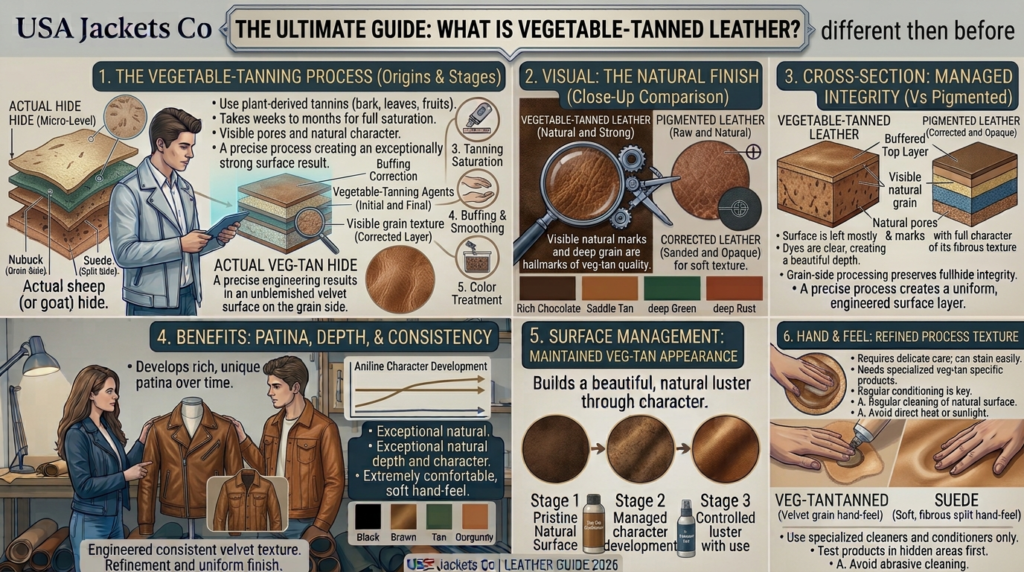
Vegetable-tanned leather is genuine animal hide stabilised using tannins extracted from plant materials such as tree bark, leaves, wood and certain fruit or seed pods. The tannins interact with the hide’s collagen structure and turn a perishable raw skin into durable leather. The method is traditional and can produce leather with a firm, substantial feel that often develops a visible patina as it is handled and exposed to light.
For buyers, the most important point is that vegetable tanning describes how the hide is tanned. It does not tell you whether the leather is full-grain or top-grain, whether it comes from cow or sheep, or whether the finished surface is aniline, semi-aniline or pigmented. Those are separate choices that influence the finished material.
What Is Vegetable-Tanned Leather?
Vegetable-tanned leather, often shortened to “veg-tan,” is leather made using plant-derived tannins. Tannins are naturally occurring compounds found in many plants. In a tannery, selected extracts are prepared and used in controlled tanning baths or drums. The process stabilises the collagen fibres so the hide becomes leather rather than continuing to decompose.
Common sources of vegetable tanning extracts include oak, chestnut, mimosa and quebracho. Different tannin blends, concentrations and processing methods can produce different shades, firmness and working characteristics. Therefore, not every vegetable-tanned leather looks or feels exactly the same.
Vegetable-tanned leather is still animal hide. “Vegetable” refers to the tanning agents, not to a plant-based substitute. It is not vegan leather.
How Is Vegetable-Tanned Leather Made?
The exact production route varies by tannery, hide and desired end use, but the broad process includes several stages:
- Preparation: The raw hide is cleaned and prepared. Hair, flesh and unwanted residues are removed through the usual beamhouse operations.
- Pre-tanning treatment: The hide is adjusted so tanning agents can penetrate evenly. This may include soaking, liming, deliming, bating and pickling as appropriate to the tannery’s process.
- Tannin application: The hide is treated with plant-derived tannin extracts. Traditional pit systems may use a sequence of baths with changing concentrations; modern tanneries may use drums or other controlled systems.
- Penetration and fixation: Tannins enter the hide and interact with collagen. The time and conditions depend on the leather specification and the method used.
- Finishing: The leather may be dyed, oiled, softened, dried, plated, buffed or coated to achieve the required appearance and performance.
Vegetable tanning is often slower than chrome tanning, but there is no single duration that applies to every tannery or leather. Pit-tanned and drum-tanned processes can differ substantially. A finished hide may also receive additional retanning or finishing treatments after its main tannage.
What Does Vegetable-Tanned Leather Look and Feel Like?
Many vegetable-tanned leathers have a firm, dense hand and a natural warm colour before final dyeing or finishing. They can hold an edge, take impressions and maintain a structured shape. Depending on the recipe and finishing, the leather may be quite rigid or may be softened for a more flexible application.
One of its best-known characteristics is patina. With use, exposure to light and contact with skin oils, some vegetable-tanned leathers darken and develop changes in colour and surface character. The degree of change depends on the original shade, finish, use and storage. A heavily coated or darkly dyed veg-tan leather may show a less dramatic patina than an unfinished natural hide.
Vegetable-Tanned vs Chrome-Tanned Leather
The main difference is the tanning chemistry, not whether one is “real” and the other is not. Vegetable tanning uses plant tannins. Chrome tanning uses chromium(III) tanning salts under controlled conditions. Both methods can produce genuine leather, and both can be used in products with different performance needs.
| Feature | Vegetable-tanned | Chrome-tanned |
|---|---|---|
| Main tanning agent | Plant-derived tannin extracts | Chromium(III) tanning salts |
| Typical hand feel | Often firmer and more structured | Often softer and more pliable |
| Ageing | Can develop a pronounced patina | Often keeps a more consistent appearance, depending on finish |
| Water behaviour | Unfinished surfaces can spot or darken when wet | Often more tolerant of moisture, but not automatically waterproof |
| Common applications | Belts, saddlery, structured goods, wallets and some bags | Garments, footwear, upholstery and many soft leather goods |
| Colour and finish options | Can be dyed and finished, but natural tones are common | Can be finished in a wide range of colours and hand feels |
These are broad tendencies, not rules. Oils, retanning, dyeing and topcoats can change the feel and water behaviour of either type. A chrome-tanned leather can be firm, and a vegetable-tanned leather can be softened. Ask about the finished article rather than assuming the tanning label tells the whole story.
Is Vegetable-Tanned Leather Always Purely Vegetable-Tanned?
No. Tanneries can use combination tanning. A hide may receive a primary chrome tannage and then be retanned with vegetable extracts, or it may undergo a different sequence of treatments. This can combine characteristics from more than one tanning method.
That distinction matters when a product is advertised simply as “vegetable-tanned.” If you specifically want leather whose primary tannage is vegetable, ask the seller to confirm whether it is pure vegetable-tanned or combination-tanned. Also ask whether the finished surface has a pigment coating, wax, oil or other treatment. A “vegetable finish” or “vegetable look” is not necessarily the same as vegetable tanning.
Why Is Vegetable-Tanned Leather Used?
It can hold its shape
Its firm structure can be useful for products that need to keep a defined form, such as belts, straps, saddlery and structured bags. It can also accept embossing, carving and tooling in suitable weights.
It can develop a distinctive patina
Buyers who enjoy visible ageing often choose natural or lightly finished vegetable-tanned leather because handling and light can gradually deepen its colour. The marks of use become part of the appearance rather than something the owner necessarily wants to hide.
It offers a traditional material character
The feel, colour range and working properties can appeal to people who value traditional leather goods and craft techniques. However, a traditional process does not automatically mean that every product made with it is better constructed or longer-lasting.
Can Vegetable-Tanned Leather Be Used for Jackets?
Yes, but it is less common in soft, lightweight fashion jackets than some other tanning routes. Many vegetable-tanned leathers are made for structured products and may feel too firm or heavy for a jacket designed to drape closely around the body. That does not mean all veg-tan is stiff: the tannery can adjust the recipe, oils, thickness and finishing to suit a garment application.
If you are considering a vegetable-tanned jacket, ask to see a swatch or a finished sample. Check how the leather bends at the elbows, under the arms and around the shoulders. A jacket needs to move with the wearer, so a very rigid leather may be uncomfortable even if it is attractive as a flat hide.
Also check the lining, pattern, seam construction, pocket placement and total weight. The tanning method alone cannot tell you whether the jacket will fit well or suit your climate. Our full-grain leather guide explains another important part of the material specification: the grain layer used.
Benefits and Limitations of Vegetable-Tanned Leather
Potential benefits
- Uses plant-derived tannin extracts in the tanning stage.
- Can produce firm leather that holds structure and takes tooling well.
- Often develops a visible, individual patina with use.
- Can be dyed, oiled and finished for different appearances.
- Can be used in durable goods when the hide selection, construction and care are appropriate.
Potential limitations
- Some vegetable-tanned leathers begin firm and may not suit soft, draped garments.
- Unfinished or lightly finished surfaces can show water spots and darken when wet.
- Natural colour may change with light and handling, which not every buyer wants.
- The method can take more time and skilled process control than faster tanning routes.
- The label alone does not prove a product is environmentally preferable or better quality.
Does Vegetable-Tanned Mean More Environmentally Friendly?
It is reasonable to say that vegetable tanning uses plant-derived tannins rather than chromium salts in its tanning stage. It is not reasonable to conclude from that fact alone that every vegetable-tanned leather product has a lower overall environmental impact.
Environmental performance also depends on where tannin extracts come from, how much water and energy are used, how wastewater is treated, what chemicals are used in preparation and finishing, how waste is managed and how long the finished product lasts. Chrome tanning also uses chromium(III), and responsible process control, recovery and wastewater treatment are important. The real assessment requires information about the tannery and its operations, not just a marketing phrase.
If environmental credentials matter to you, ask for specific, verifiable information about the tannery, its audit or certification status, chemical management and wastewater treatment. Avoid treating words such as “natural,” “green” or “eco-friendly” as proof on their own.
How to Choose a Vegetable-Tanned Leather Product
- Confirm the tannage. Ask whether the hide is primarily vegetable-tanned or combination-tanned, and whether the description refers only to a surface finish.
- Check the leather grade. Find out whether it is full-grain, top-grain or split leather. Our split leather guide explains why the hide layer matters.
- Look at the finish. Natural, dyed, waxed, oiled and coated surfaces age differently and need different care.
- Assess the firmness. For a belt or structured bag, firmness may be desirable. For a jacket, check drape and movement in a physical sample.
- Ask how the colour will change. Natural veg-tan may darken noticeably. Make sure you like the expected ageing process.
- Understand moisture care. Ask what to do if the product gets wet and which conditioner or protective treatment is approved.
- Inspect construction. Stitching, edge finishing, hardware, lining and pattern quality matter just as much as the tannage.
- Check seller policies. Review sizing, returns, repairs and warranty terms before ordering.
For general leather care, see our guide to cleaning and conditioning a leather jacket. Always follow the care instructions for the specific finish, because a product suitable for one leather may be unsuitable for another.
How to Care for Vegetable-Tanned Leather
Keep the item clean and dry it naturally if it becomes damp. Blot moisture with a clean, absorbent cloth; do not rub hard or use a hair dryer, radiator or direct sunlight to force drying. Allow air to circulate around the leather. Water marks may be more visible on natural, unfinished surfaces, so prevention is easier than trying to remove a set stain.
Use conditioner sparingly and only if the manufacturer recommends a product compatible with the finish. Excess oil or wax can darken the leather, alter its feel or create uneven patches. Test any product in a hidden area first. Store leather goods away from prolonged sunlight, high heat and sealed plastic packaging.
Frequently Asked Questions
Is vegetable-tanned leather real leather?
Yes. It is genuine animal hide tanned with plant-derived tannins.
Is vegetable-tanned leather vegan?
No. The tanning agents come from plants, but the material itself is animal hide. Vegetable-tanned leather is not a vegan substitute.
Is vegetable-tanned leather waterproof?
No. Unfinished vegetable-tanned leather can absorb water, darken or develop spots. Some finishes improve moisture resistance, but no buyer should assume the material is waterproof without a specific tested claim.
Does vegetable-tanned leather get softer?
Many types soften and mould with use, but the amount depends on thickness, tannage, oils, finish and construction. A thick strap leather will not become as drapey as a lightweight garment leather simply through wearing.
Does vegetable-tanned leather develop a patina?
Often, yes. Light, handling and oils can deepen the colour and create a more individual surface. The effect is strongest on natural or lightly finished leathers and less obvious on heavily coated surfaces.
Is vegetable-tanned leather better than chrome-tanned leather?
Neither is best for every product. Vegetable tanning is often chosen for structure and patina, while chrome tanning is commonly used where softness, flexibility and consistent colour are priorities. The right choice depends on the item and the finished leather specification.
Is vegetable-tanned leather always more sustainable?
No. Plant tannins are one factor, but overall environmental performance depends on sourcing, energy, water, wastewater treatment, chemical management and product lifespan. Look for specific evidence about the tannery rather than relying on the name of the tanning method.
Final Takeaway
Vegetable-tanned leather is defined by the plant-derived tannins used to stabilise the hide. It is valued for its traditional character, structure and potential to develop patina, but it can be firmer and more sensitive to water spotting than some other leathers. It is not automatically the best choice for a soft leather jacket or the most sustainable option. Check the tannage, hide grade, finish, weight, construction and care requirements together so you know exactly what you are buying.
