
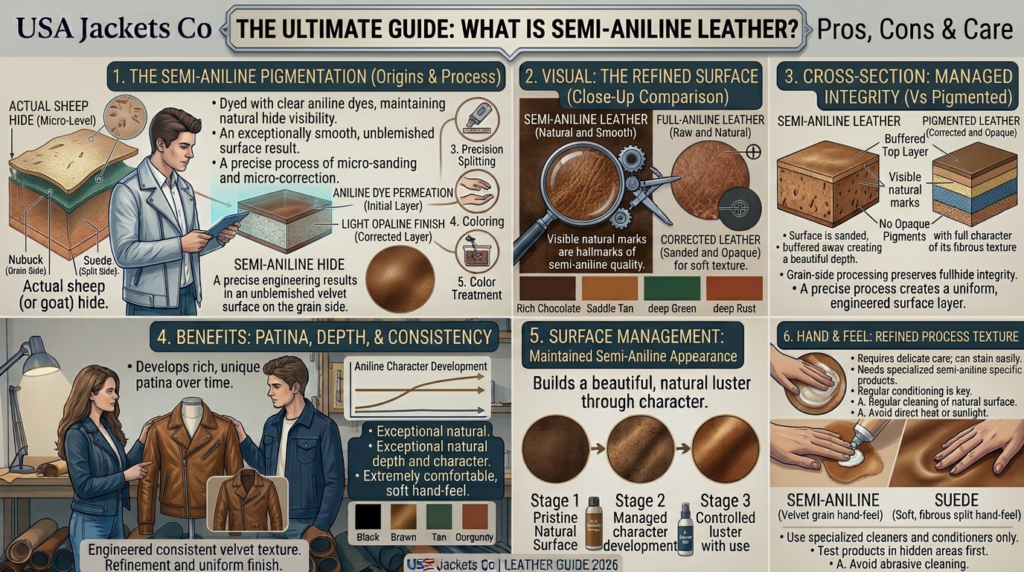
Semi-aniline leather is real animal hide that has been coloured with soluble dyes and then given a light protective surface finish, sometimes containing a small amount of pigment. The thin finish helps even out the colour and gives the surface some extra resistance to everyday marks while leaving much of the natural grain visible. For a leather jacket buyer, it can offer a useful middle ground between the open, highly natural appearance of full-aniline leather and the more uniform look of heavily pigmented leather.
The important point is that semi-aniline describes a finish, not the animal, leather grade or tanning method. A semi-aniline jacket may be made from different hides and grades. Its actual feel and performance depend on the hide, the finish formula, the leather weight and the way the jacket is constructed.
What Does Semi-Aniline Leather Mean?
Aniline refers to a dyeing approach in which soluble dyes colour the hide without hiding its natural grain beneath an opaque paint-like layer. Full-aniline leather is generally left without a substantial protective pigment coating, so pores, wrinkles and natural variations remain easy to see. Semi-aniline leather starts with a similar dyeing approach but receives an additional light surface treatment.
That treatment may be transparent or lightly pigmented. It is designed to provide a degree of surface protection and colour consistency without completely covering the character of the hide. Natural grain should still be visible, although small marks and colour differences may look less pronounced than they do on full-aniline leather.
There is no single universal recipe used by every tannery. The thickness, chemistry, sheen and pigment content of the finish can vary. When a product description simply says “semi-aniline,” ask the seller for the leather specification if those details matter to your purchase.
How Is Semi-Aniline Leather Made?
The process begins with a prepared hide that has been tanned and finished to the condition required by the tannery. The hide is coloured with soluble dyes, commonly in a rotating drum, so the colour penetrates the leather rather than relying only on a surface layer. A light finishing coat is then applied to help protect the surface and refine the appearance.
- Hide selection and preparation: The tannery grades and prepares the hide. The natural grain and existing marks influence the final appearance.
- Dyeing: Soluble dyes add colour while allowing much of the underlying grain to remain visible.
- Light surface finishing: A thin clear or lightly pigmented finish is applied. The exact formulation differs between suppliers.
- Finishing and inspection: The leather is dried, softened or adjusted as required, then checked for colour, feel and surface consistency before it is made into a product.
This is a simplified description rather than a fixed factory recipe. Tannery processes differ, and some leathers receive additional treatments. The finished specification is more useful to a buyer than assumptions based on the label alone.
Semi-Aniline Is a Finish, Not a Leather Grade
Leather terminology often mixes together several separate decisions. Keeping them apart makes product descriptions easier to understand:
- Hide source identifies the animal, such as cow, sheep, lamb or goat.
- Leather grade describes which part of the hide is used and how its grain surface has been treated, such as full-grain, top-grain or split leather.
- Tanning method describes how the raw hide is stabilised, for example by chrome, vegetable or combination tanning.
- Finish describes the treatment of the visible surface, such as aniline, semi-aniline, pigmented, waxed or distressed.
So “semi-aniline” does not automatically mean full-grain, top-grain, lambskin, cowhide, vegetable-tanned or premium. Those are separate specifications. For a broader explanation of grain and hide layers, see our guide to full-grain leather and our comparison of top-grain and full-grain leather.
Semi-Aniline vs Full-Aniline vs Pigmented Leather
| Feature | Full-aniline | Semi-aniline | Heavily pigmented |
|---|---|---|---|
| Surface finish | Little or no opaque protective coating | Light protective finish, sometimes lightly pigmented | More substantial pigmented surface layer |
| Natural grain | Highly visible | Usually visible, with some marks softened | Can be partly or largely obscured |
| Colour consistency | Natural variation is more apparent | Somewhat more even | Usually the most uniform |
| Surface protection | Limited | Some additional protection | Generally greater resistance to surface marks and soiling |
| Care needs | More careful handling | Still needs leather-specific care | Often simpler routine cleaning, subject to maker instructions |
These are general tendencies, not performance guarantees. A well-made semi-aniline leather can vary from another semi-aniline leather because the hide, coating and finishing process are not identical. A thin finish does not make a jacket waterproof or immune to scratches.
Why Choose a Semi-Aniline Leather Jacket?
It keeps much of the hide’s natural character
If you like visible pores, grain variation and the organic appearance of real leather, semi-aniline can preserve those details better than a thick opaque finish. The jacket may look less uniform than a fully coated garment, which is part of the appeal for buyers who prefer natural material.
It offers a practical compromise
The light finish can make the surface more forgiving than uncoated full-aniline leather when it comes to light handling marks or minor soiling. That can be useful on a jacket worn regularly. The degree of improvement depends on the particular finish, so do not interpret the term as a promise of stain-proof performance.
It can retain a supple hand feel
Because the surface coating is relatively light, many semi-aniline leathers retain a soft, natural feel. However, softness also depends on the hide, thickness, oils, tanning and mechanical finishing. A heavy semi-aniline hide may feel firmer than a lightweight leather with another finish.
It can look refined without appearing overly coated
Semi-aniline finishes are available in different sheens and colours. A restrained matte or low-sheen finish can suit classic bombers, racers and everyday jackets, while a more even colour can help a multi-panel garment look coordinated.
What Are the Limitations?
- It is not stain-proof: The finish may slow absorption, but oils, dyes, rain and spills can still mark the leather.
- It is not waterproof: Do not rely on a semi-aniline label as rain protection. Follow the maker’s guidance and dry the jacket properly if it becomes wet.
- Natural variation remains: Grain, shade and texture can differ between panels. This is normal for genuine hide, not automatically a defect.
- Finish quality varies: The name alone does not tell you the exact coating thickness, abrasion resistance or colourfastness.
- Repairs require care: Strong cleaners, household polish or an unsuitable recolouring product can change the sheen and appearance of the surface.
Is Semi-Aniline Leather Good for Everyday Jackets?
It can be a sensible option for an everyday jacket if you want a natural-looking surface with a little more protection than full-aniline leather. It is not automatically the best choice for every wearer. Someone who wants the most natural, uncoated appearance may prefer full-aniline and accept more careful maintenance. Someone who prioritises a very even colour and easier surface cleaning may prefer a more heavily pigmented finish.
Think about how you will wear the jacket. A jacket used for occasional dinners may face different demands from one worn on a daily commute, packed frequently or exposed to changing weather. Also consider the leather weight, lining, fit, seam construction and hardware. A finish cannot compensate for poor pattern cutting or weak stitching.
How to Choose a Semi-Aniline Leather Jacket
- Ask what the leather is made from. Confirm the hide source and whether the leather is full-grain, top-grain or another grade.
- Request the finish details. Ask whether the surface is clear-coated or lightly pigmented and whether the maker has care instructions for that exact finish.
- Look at close-up photographs. Check whether the natural grain is visible and whether the colour looks consistent across the panels.
- Check the hand feel if possible. A physical swatch can reveal softness, body and surface feel more reliably than a product photograph.
- Check the jacket’s construction. Inspect seams, lining, zips, pocket reinforcement, collar shape and how the sleeves move.
- Read the size chart and return terms. Leather should fit comfortably across the shoulders and chest without relying on the material to stretch significantly.
- Confirm the care routine. Ask which cleaner or conditioner, if any, is suitable. Do not assume products made for pigmented leather are appropriate for every semi-aniline finish.
Our 15-point leather jacket buying checklist can help you assess the whole garment rather than focusing on the finish alone.
How to Care for Semi-Aniline Leather
Use a conservative routine. Brush away dry dust with a soft cloth, and deal with fresh spills promptly by blotting rather than rubbing. Avoid soaking the surface or using household detergents, alcohol, solvents or abrasive pads. If the maker permits a damp cloth, use minimal moisture and test first in a hidden area.
Conditioning is not automatically required on a fixed monthly schedule. Too much conditioner can darken leather or leave residue, and an incompatible product can affect the finish. Follow the jacket manufacturer’s instructions. For significant stains, colour transfer or damage, consult a leather-care specialist familiar with semi-aniline finishes.
Store the jacket on a broad, supportive hanger in a cool, dry, ventilated place. Keep it away from prolonged direct sunlight and do not seal it in plastic. If it gets wet, gently blot surface moisture and let it air-dry naturally, away from radiators and direct heat.
Questions to Ask Before You Buy
- Is the leather semi-aniline throughout the jacket or only on selected panels?
- What is the hide source and leather grade?
- Is the finish clear or lightly pigmented?
- What level of water, stain or rub resistance has actually been tested?
- Which cleaning and conditioning products are approved?
- Can the seller provide a close-up image or swatch of the actual leather?
Frequently Asked Questions
Is semi-aniline leather real leather?
Yes. Semi-aniline describes the finish applied to genuine animal hide. It is not a synthetic material.
Is semi-aniline better than aniline leather?
Neither is universally better. Full-aniline offers a more open, natural surface and shows variation more clearly. Semi-aniline adds a light protective finish that can make the leather more practical for regular use, while retaining much of its natural appearance.
Does semi-aniline leather peel?
A properly made leather surface should not behave like a low-quality synthetic coating simply because it is semi-aniline. However, any finish can be damaged by age, poor storage, incompatible chemicals or manufacturing defects. Ask about the actual finish and warranty rather than relying on the label.
Is semi-aniline leather waterproof?
No. A light protective finish may improve resistance to some surface moisture, but it does not make the jacket waterproof. Avoid heavy rain where possible and follow the maker’s drying instructions.
Does semi-aniline leather develop a patina?
It can change with use, light and handling, but the protective layer may slow or soften the changes compared with full-aniline leather. The result depends on the finish formulation and how the jacket is worn.
Is semi-aniline the same as top-grain leather?
No. Top-grain describes the part of the hide and its grain treatment; semi-aniline describes the surface finish. A leather can be top-grain and semi-aniline at the same time.
Final Takeaway
Semi-aniline leather combines a dyed, natural-looking hide with a light surface finish. It can suit buyers who want visible grain and a supple feel without choosing the least-protected aniline finish. But the term is only one part of the specification. Check the hide grade, tanning method, finish details, construction, fit and care instructions before deciding whether a semi-aniline jacket is right for your wardrobe.
