
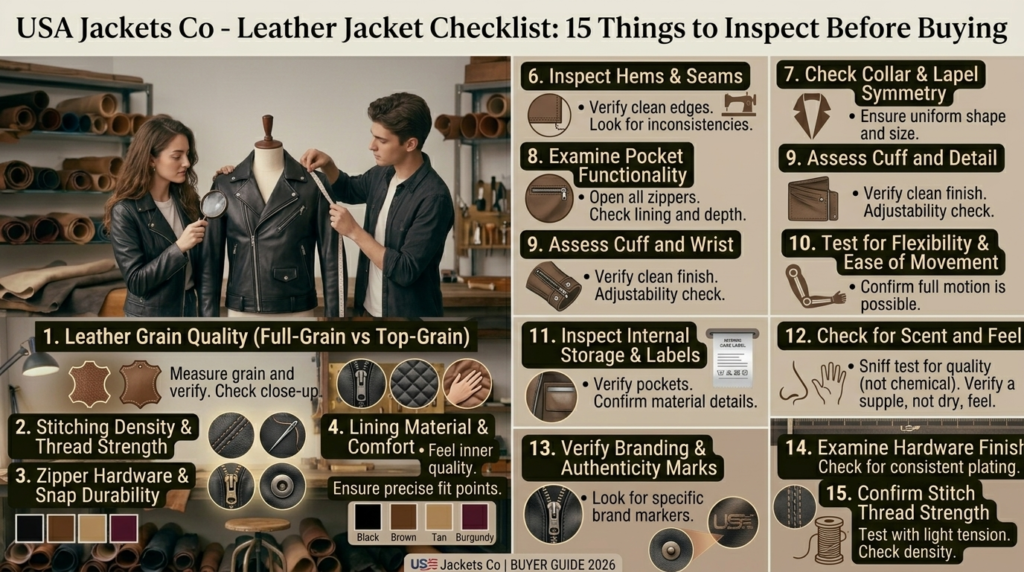
A leather jacket can look excellent in product photos and still disappoint after delivery if the fit, finish, construction, or seller details do not match your needs. Before you pay, inspect more than the colour and style. Use this practical 15-point leather jacket checklist to compare options consistently, whether you are shopping online or examining a jacket in person.
The goal is not to find a jacket with no natural marks or to assume the most expensive option is automatically the best. It is to understand what you are buying, how it should fit, how it is made, and whether it suits the way you will wear it.
The 15-point leather jacket checklist
1. Confirm the jacket’s intended use
Start with the job you want the jacket to do. A lightweight fashion jacket for commuting and weekends has different priorities from a winter coat or motorcycle garment. Everyday wear usually benefits from versatile styling, comfortable movement, practical pockets, and a manageable weight. Cold-weather use calls for appropriate lining and enough room for layers. A riding jacket should be specifically designed and documented as protective motorcycle clothing; a biker-inspired fashion jacket is not automatically protective equipment.
Write down your two or three main uses before comparing products. This prevents you from paying for dramatic details that do not help with your routine.
2. Read the leather description carefully
Look for the hide type and leather grade, not just a general phrase such as “real leather.” Cowhide, goatskin, lambskin, and sheepskin can feel and behave differently, while full-grain, top-grain, corrected-grain, suede, and nubuck describe other aspects of the material or finish. These terms are not interchangeable, and none tells the whole story by itself.
If a product page leaves the material vague, ask the seller for clarification. A useful description should explain the shell material clearly and avoid promising that every hide will look identical.
3. Check whether natural marks are expected
Natural leather can show small variations in grain, creases, tone, or texture. These are not automatically defects. On a jacket marketed as having a uniform, polished finish, however, you should still expect a reasonably consistent overall appearance. On distressed or pull-up leather, variation may be part of the intended look.
Look for clear product photos that show the material close up. If a mark looks like a cut, deep scratch, peeling coating, or damaged seam rather than a natural variation, ask for a close-up before purchasing.
4. Match the leather weight to your plans
Heavier leather is not automatically superior. A substantial hide may suit a structured jacket or certain riding applications, while a lighter leather can be more comfortable for daily wear and travel. The right choice depends on the design, construction, lining, and intended use.
When shopping online, check any available weight or thickness information and look for a description of the jacket’s feel. If no specification is given, do not guess from a photo; ask whether the jacket is lightweight, medium-weight, or substantial and whether it is intended for layering.
5. Measure a jacket you already own
Do not rely on your usual T-shirt size alone. Clothing sizes vary between brands and countries, and leather jackets often have less give than knitwear. Lay a jacket that fits you well on a flat surface and compare its chest width, shoulder width, sleeve length, and back length with the seller’s size chart.
Check whether the seller’s measurements describe the garment itself or the body that should wear it. Those are different measurements. If the chart is unclear, request instructions before ordering.
6. Check the shoulders and chest first
The shoulder seams should generally sit near your natural shoulder points for a conventional fit. The chest should close without strong pulling, rippling, or strain around the zipper. A slim racer may fit closer than a relaxed bomber, so judge the measurements against the intended silhouette rather than expecting every style to fit the same way.
Plan for the layers you will actually wear. If you expect to wear a sweatshirt or sweater underneath, measure while wearing a similar layer. Do not buy a painfully tight jacket assuming leather will stretch enough to fix the problem.
7. Test movement and sleeve length
When trying a jacket on, zip it up and move naturally. Reach forward, sit down, raise your arms, and turn your torso. The jacket should allow the movements you need without severe pulling across the back or cutting into the underarms. Some upward movement at the hem is normal when you reach; constant restriction is not.
Check the sleeves with your arms relaxed and slightly bent. The ideal endpoint depends on the design, but cuffs should not ride far above the wrist during ordinary movement. If you are buying remotely, compare sleeve measurements with a jacket that fits.
8. Inspect the stitching and seams
Examine the areas that receive repeated movement: shoulder seams, armholes, side seams, cuffs, pocket openings, and the base of the main zipper. Stitches should be reasonably even and secure, with no obvious skipped sections, loose loops, or unraveling threads. Panel joins should sit flat rather than forming unexplained bunches.
Decorative stitching can be part of a design, but decoration is not proof of structural strength. For a riding garment, review the manufacturer’s documented construction and protective features rather than judging safety by appearance.
9. Look inside at the lining
The lining influences comfort, how easily the jacket slips over other clothes, and whether the inside feels finished. It should generally lie flat and be attached cleanly around the sleeves, hem, and armholes. A twisted or badly caught lining can make a jacket frustrating to put on even when the outer leather looks good.
Ask for an inside photo if the product page only shows the exterior. Check whether the lining is fixed or removable and whether the seller describes any insulation. Do not assume a leather shell is warm enough for winter without considering the lining and the clothes worn underneath.
10. Check zippers, snaps, and buttons
Closures should suit the jacket and look properly aligned. On an in-person purchase, operate the main zipper several times without forcing it. Check that snaps close securely and buttons are firmly attached. For an online purchase, look for close-up photographs and a product description that identifies the type of closure.
Also consider the finish. Shiny metal, matte hardware, and aged-looking finishes create different visual effects. Choose details that work with your usual shoes, bags, and accessories rather than treating hardware as an isolated feature.
11. Test the pockets for real use
Count the pockets and consider their placement. Are they easy to reach when standing or seated? Do they close securely? Is there an inside pocket for a phone, card holder, or travel document? Pocket depth and closure matter more than the number alone.
For travel, secure pockets may be particularly useful. For a clean minimalist jacket, fewer pockets may be part of the design. Decide which trade-off works for you instead of assuming more pockets always means better quality.
12. Assess the finish and colour
Check whether the finish is matte, glossy, pebbled, smooth, suede-like, distressed, or otherwise textured. The product images should represent the intended finish accurately. Colour can vary between screens, so look for several photographs under different lighting if available.
Choose a shade that fits your wardrobe. Black is easy to combine with dark denim, neutral trousers, boots, and sneakers. Brown often pairs naturally with blue denim, cream, olive, and earth tones. Lighter or more unusual colours can be excellent statement choices, but think about how often you will wear them.
13. Understand care and weather limits
Before buying, read the care instructions. Many leather jackets should not be machine washed, tumble dried, bleached, or ironed. Suede and nubuck need different surface care from smooth finished leather, and some finishes are more sensitive to moisture or staining.
Leather is not automatically waterproof. If your daily routine involves frequent rain, check the maker’s guidance and plan to protect and dry the jacket appropriately. After unexpected moisture, blot gently and let the jacket dry naturally away from direct heat. For more help, review the care instructions supplied with the garment and our leather jacket buying guide.
14. Review the seller’s shipping, return, and exchange terms
A good product decision includes the buying process. Check dispatch estimates, delivery methods, tracking, return eligibility, exchange steps, and whether customized items have different conditions. Look for a clear contact method in case the measurements or product details need clarification.
Read the policy before checkout, not after the parcel arrives. If the return window is short or international return shipping is costly, take extra care with measurements and save a copy of the product details and order confirmation.
15. Compare the full value, not just the price
Price matters, but it should be weighed against the material description, workmanship, fit, lining, hardware, aftercare, and seller support. A discount is useful only if the jacket still meets your needs. A premium price should come with clear information that helps explain what you are paying for.
Compare two or three jackets using the same checklist. If a product is expensive but provides little information about leather, measurements, or construction, do not assume the price alone proves quality. If a more affordable option gives clear specifications and suits your use, it may be the more sensible choice.
Quick inspection table
| Area | What to look for | Reason to pause |
|---|---|---|
| Material | Specific hide and finish description | Vague claims or conflicting details |
| Fit | Clear measurements and room to move | Missing chart or severe chest/shoulder strain |
| Construction | Even stitching and tidy seams | Skipped stitches, unraveling, or separated seams |
| Interior | Flat, neatly attached lining | Twisting, catching, or visible attachment problems |
| Hardware | Aligned, secure closures | Misaligned snaps or a zipper that catches |
| Policies | Clear delivery and return terms | Important conditions are missing or unclear |
Common buying mistakes to avoid
- Choosing by photo alone: images cannot reliably communicate weight, feel, fit, or construction.
- Confusing leather terms: hide type, grade, and finish describe different things.
- Buying too small: leather may relax slightly, but it should fit comfortably from the start.
- Ignoring the lining: the interior can affect comfort as much as the shell.
- Assuming fashion means protection: a biker-style jacket is not necessarily certified riding gear.
- Skipping the policy page: sizing uncertainty and return costs are easier to manage before checkout.
Frequently asked questions
What is the most important thing to check before buying a leather jacket?
Start with the intended use, accurate measurements, and a clear description of the leather. A jacket that fits your routine and body is more useful than one selected only for its appearance or price.
Is full-grain leather always the best choice?
Not for every buyer. Full-grain leather retains more of the hide’s natural surface and is often chosen for character and long-term wear, but the finish, construction, fit, and care needs still matter. A well-made jacket in another leather grade may suit your priorities better.
Should a new leather jacket feel tight?
It can feel structured or slightly firm, depending on the hide and cut, but it should not cause pain or strongly restrict movement. Check the fit with the layers you plan to wear and do not count on major stretching to correct the size.
Can I judge leather quality from a product photo?
Photos can help you inspect grain, finish, panel alignment, and visible stitching, but they cannot prove thickness, tanning quality, or long-term performance. Use product specifications and ask questions where details are missing.
What should I check when buying a leather jacket online?
Review the material description, garment measurements, lining, hardware, care instructions, shipping estimate, and return policy. Save the product page and compare its measurements with a jacket you already own.
Make the checklist part of your purchase
Before checkout, run through all 15 points and resolve any unanswered questions. If you want a jacket made around a particular style or set of details, explore custom leather jackets from USA Jackets Co and confirm the available options before placing an order. For a more general comparison of fit, material, and construction, return to our guide to choosing a jacket for your lifestyle.
The best purchase is the one you understand before you pay: the material is clearly described, the measurements make sense, the construction looks sound, and the jacket fits the way you plan to use it.
