
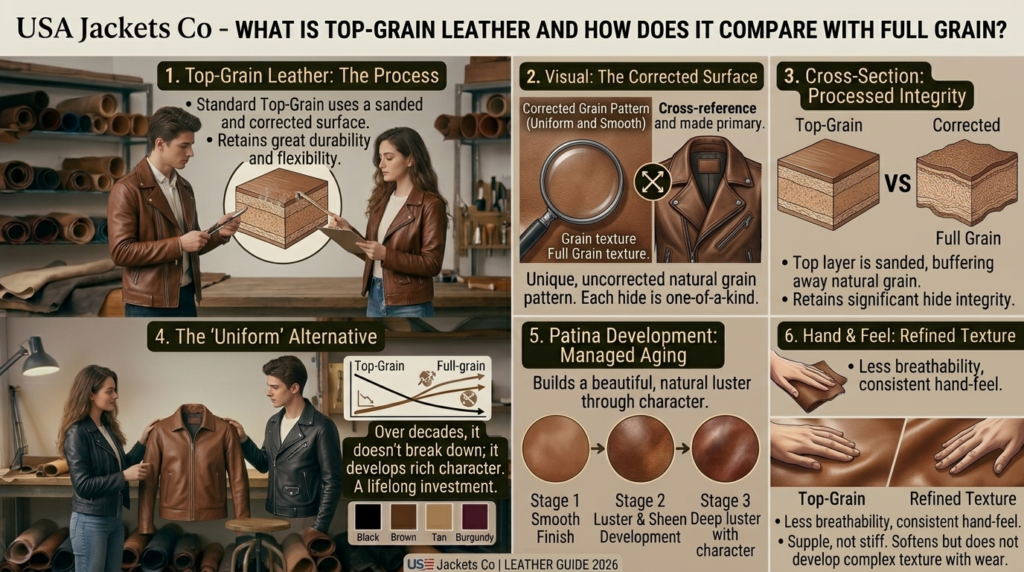
Top-grain and full-grain are two terms you will often see when comparing leather jackets. Both refer to the outer layer of an animal hide, but they describe different amounts of surface alteration. That difference can affect appearance, consistency, price, and how a jacket changes with wear. It does not, by itself, tell you everything about quality.
This guide explains what each term means, how to compare them fairly, and what to ask a seller before buying. The practical goal is to choose a jacket whose material, finish, fit, and care needs suit the way you plan to wear it.
What does “grain” mean in leather?
The grain is the outer surface of the hide. It has a natural pattern shaped by the animal’s skin, including pores and small variations. After tanning, makers may leave this surface largely intact, lightly refine it, or alter it more substantially to create a uniform look. The name of a leather grade describes part of that process; it is not a complete inspection report.
Hide selection, tanning, thickness, finishing, stitching, lining, patterning, and quality control all matter. Two jackets described with the same grade can feel and perform differently.
What is full-grain leather?
Full-grain leather keeps the hide’s outer grain layer without sanding away the natural grain to remove surface marks. The surface may still be dyed or treated with a finish, so “full-grain” does not necessarily mean untreated, raw, or completely uniform. Natural marks can remain visible, and individual panels may vary.
Some buyers value that variation because it makes the jacket look less manufactured and allows the surface to develop character. Others prefer a more even appearance. Full-grain is not automatically softer, heavier, more comfortable, or more durable in every jacket. Those qualities depend on the hide and how the garment is made.
What full-grain can mean for a jacket buyer
- Visible variation: Grain, pores, and small natural marks may show through, depending on the finish.
- A distinctive surface: Panels can vary subtly rather than matching like printed fabric.
- Care still matters: Dyes and finishes differ; follow the maker’s instructions rather than assuming every full-grain jacket should be conditioned the same way.
- Ask about the whole build: Grain grade does not tell you the jacket’s thickness, lining, fit, or seam construction.
What is top-grain leather?
Top-grain leather also comes from the hide’s outer layer. The surface is commonly sanded, buffed, or otherwise refined to reduce some natural imperfections and create a more consistent appearance. It may then receive a finish or embossing. The result can look smoother and more uniform than a full-grain surface, though methods and results vary by tannery and product.
Refining the surface is not the same as making leather synthetic. Top-grain remains leather from the hide’s outer layer. A uniform finish can suit buyers who want a clean, predictable look across jacket panels. Other buyers may prefer more visible natural character.
What top-grain can mean for a jacket buyer
- More consistent appearance: Surface refinement can reduce the prominence of some marks.
- Many finish options: It can be finished to look matte, smooth, or more polished.
- No automatic comfort guarantee: Softness depends on leather selection and processing, not just the grade name.
- Check the description: Ask whether the surface is embossed, heavily coated, or treated in another way if the look and feel matter to you.
Full-grain vs top-grain: a practical comparison
| Question | Full-grain | Top-grain |
|---|---|---|
| Which part of the hide? | Outer grain layer retained without sanding away the natural grain | Outer grain layer with a surface that is commonly refined |
| Typical appearance | Natural variation may be more visible | Often more even or uniform |
| Best for a buyer who prefers | Individual character and visible grain | A more consistent surface and finish |
| Does the term prove jacket quality? | No; construction and material details still matter | No; construction and material details still matter |
| Does it specify care? | No; use the maker’s care guidance | No; use the maker’s care guidance |
Which should you buy?
Choose based on the surface you want and the specific jacket in front of you. If you enjoy natural variation and want the grain to remain an obvious part of the look, start by comparing full-grain options. If you prefer a more controlled, even finish, top-grain may be a better match.
Then assess the garment itself. Try to find clear photographs of the front, back, sleeves, seams, and interior. Read the material description closely. Check the size chart, return conditions, shipping expectations, lining, pockets, closures, and care instructions. A well-made jacket that fits your daily needs is a better choice than a grade label that sounds impressive but leaves important questions unanswered.
How to compare leather claims online
- Look for a specific material statement. Does the page say full-grain or top-grain for the jacket’s shell, or only use broad language such as “genuine leather”?
- Separate shell from details. Confirm whether the collar, trim, or other panels use a different material.
- Inspect close-up images. Zoom in on the grain and finish, while remembering that lighting and image editing can change how leather appears.
- Ask what the finish does. A seller should be able to explain whether the surface is natural-looking, buffed, embossed, or coated.
- Evaluate construction. Look at seam alignment, zipper operation, lining attachment, and whether pocket placement works for you.
- Read the policies before checkout. Confirm returns, exchanges, made-to-measure terms, and who pays return shipping.
For more background, see USA Jackets Co’s guides to full-grain leather, what to check before paying, and the available leather options for custom jackets. These pages can help you connect material terminology with real product decisions.
Common misconceptions
“Full-grain always lasts longer.”
Grade alone cannot predict the life of a garment. Use, storage, moisture exposure, construction, and care all contribute. A poorly made jacket can disappoint regardless of its leather grade.
“Top-grain means fake leather.”
No. Top-grain describes leather from the hide’s outer layer that has commonly been surface-refined. Synthetic leather is a different material category. Read the actual shell description.
“More natural marks mean better leather.”
Marks may be natural, but their presence is not a reliable quality score. The hide should be suitable for the intended use, and the garment should be soundly made.
“The most expensive option must be best.”
Price can reflect many factors, including design, labor, hardware, sourcing, and brand positioning. Compare those details and your likely use instead of treating price or grade as a shortcut.
Questions to ask before buying
- Is the shell full-grain or top-grain throughout, or are multiple materials used?
- How is the surface finished, and will the finish change the visible grain?
- What is the lining made from, and what layers can I comfortably wear underneath?
- Are measurements garment measurements or body measurements?
- What care method does the maker recommend for this exact finish?
FAQs
Is full-grain better than top-grain for a leather jacket?
Neither is universally better. Full-grain keeps the natural grain more intact; top-grain is commonly refined for a more even surface. Compare appearance, construction, fit, and care for the specific jacket.
Is top-grain leather real leather?
Yes. Top-grain is leather from the hide’s outer layer that has commonly been sanded or refined. It should not be confused with synthetic leather.
Does full-grain leather have to look rough?
No. It can have different dyes and finishes. The natural grain is retained, but the final appearance depends on the hide and finishing process.
Which one is softer?
There is no reliable answer from the grade name alone. Tanning, thickness, finish, and garment design affect how a jacket feels.
Can a product listing use “genuine leather” and still be specific?
“Genuine leather” is broad wording. Ask the seller for the more precise grade and finish, plus details about the shell and construction.
Make the choice around the jacket you will wear
Full-grain and top-grain describe useful differences in the leather surface, but they are only a starting point. Decide whether you prefer natural variation or a more uniform finish, then check fit, construction, lining, hardware, policies, and care. That comparison gives you a clearer basis for choosing a jacket that feels right now and suits the way you plan to use it.
