
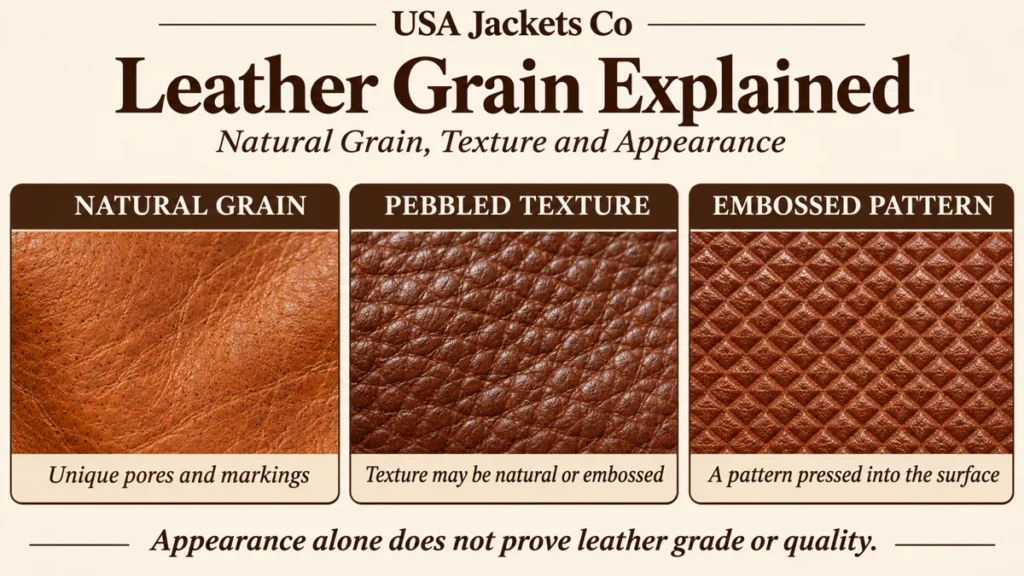
When you look closely at a leather jacket, you may notice tiny pores, fine lines, raised pebbles, natural marks or a very even surface. These details are part of the leather’s grain and finish. They influence the jacket’s appearance and can help you understand how the material has been processed, but grain alone does not tell you whether a jacket is well made.
Leather grain is the natural surface structure of an animal hide, including its pore pattern and the visible character of the outer layer. A maker may preserve that surface, lightly refine it, correct it, emboss a pattern into it or use a lower split layer with a different finish. The best choice depends on the look, feel, care requirements and construction you want.
This guide explains the main grain descriptions, how grain differs from texture and finish, and what to inspect before choosing a leather jacket. For a broader explanation of hide layers, see our guides to full-grain leather, corrected-grain leather and split leather.
What does grain mean in leather?
A hide is not a flat sheet with identical fibres all the way through. Its outer surface contains the hair follicles and the closely arranged fibre structure that creates the natural grain. Beneath that surface is a deeper, more fibrous layer. During leather production, the hide can be split into layers, and the surface can be left intact or altered to achieve a particular appearance.
When a product description mentions grain, it may be referring to one of two related things:
- The hide surface or layer: whether the original grain surface has been retained, refined or removed.
- The visible pattern: the pores, wrinkles, pebbling, embossing or other surface character you can see and feel.
Those meanings overlap in retail language, so read the complete material description. “Natural grain”, “full-grain”, “pebbled” and “embossed” do not all describe the same thing.
Common leather grain types and descriptions
The terms below help describe how the surface looks or has been treated. They are useful buying clues, not a substitute for checking the actual leather, finish and jacket construction.
| Term | What it generally means | What a jacket buyer may notice |
|---|---|---|
| Natural grain | The hide’s original surface character remains visible to some degree. | Pores, small wrinkles and panel-to-panel variation may be noticeable. |
| Full-grain | The natural grain surface is retained rather than sanded or buffed away. | Natural markings and an individual surface are often visible. |
| Top-grain | Leather from the outer layer whose surface has commonly been refined or lightly buffed. | A more even appearance may be achieved while retaining a grain-side surface. |
| Corrected-grain | The surface has been altered to reduce marks or irregularities; it may be embossed or coated. | A regular, consistent pattern and colour are common. |
| Split leather | A lower layer separated from the grain layer; it has no original grain face on that side. | It may be finished as suede or given a coating and embossed pattern. |
| Embossed grain | A pattern is pressed into the surface to create a chosen texture. | The pattern may look highly consistent across panels. |
| Pebbled grain | A rounded, raised texture that may be natural, mechanically developed or embossed. | A tactile, slightly rugged surface with visible bumps. |
For more detail on the difference between outer-layer grades, read full-grain vs top-grain leather jackets. Our separate nubuck and suede guide explains two napped finishes that are often confused with grain patterns.
Natural grain: why every hide looks a little different
Natural leather is made from an organic material, so two hides rarely have identical surface patterns. Pore size, wrinkles, healed marks, creases and the way a panel was cut can all change the final appearance. Even different areas of one hide can show different grain character.
That variation is not automatically a defect. A small healed mark or a change in pore pattern may simply be part of the hide’s natural character. However, natural variation should not be confused with damage. A deep cut, loose surface, peeling coating, open seam or badly placed flaw deserves a clear explanation from the seller.
Fine grain and pronounced grain
Some leather has a fine, close-looking grain that appears smooth from a normal viewing distance. Other leather has a more pronounced or coarse pattern. Neither is automatically superior. Fine grain can suit a clean, understated jacket, while a more pronounced pattern may work well with a rugged or vintage-inspired design. The hide, tanning, finish and thickness still matter.
Grain, texture and finish are not interchangeable
These words are often used together in product descriptions, but they answer different questions:
- Grain describes the hide’s surface structure and the treatment of that surface.
- Texture describes what the surface looks and feels like, such as smooth, pebbled, brushed or embossed.
- Finish describes the treatments applied to colour and protect the surface, such as aniline, semi-aniline, waxed or pigmented finishes.
- Leather type may identify the animal source or a material treatment, such as cowhide, lambskin, suede or nubuck.
A jacket can, for example, use a top-grain hide with a smooth pigmented finish, or a grain-side hide that has been buffed to create nubuck. A pebbled appearance may be natural or embossed. Ask the seller to separate these details rather than relying on one attractive adjective.
How grain affects the look of a leather jacket
Natural and lightly finished surfaces
When the original surface remains visible, the jacket can have a more individual appearance. Natural grain may be especially appealing if you like subtle variation and the possibility of visible ageing. The way it changes over time depends on the dye and finish as well as how the jacket is worn and cared for. A heavily coated surface may show less visible change even if the underlying hide retains its grain.
Corrected or embossed surfaces
A corrected or embossed surface can create a more uniform look from one panel to another. This can be useful when you prefer consistent colour and pattern. The trade-off is that the original surface character may be less visible. The amount of correction and the type of coating vary, so do not assume every corrected leather has the same hand-feel or performance.
Suede and nubuck surfaces
Suede and nubuck have a soft, napped surface rather than a conventional smooth grain appearance. Suede is commonly made from a split surface, while nubuck is created by lightly buffing the grain side. Their surface character and care needs differ from smooth finished leather. See the nubuck vs suede explanation before choosing one for regular use.
Does a visible grain pattern mean better quality?
No. A visible natural grain can be a sign that the surface has not been heavily corrected, but it does not prove that the jacket is high quality overall. A beautiful grain pattern cannot compensate for weak stitching, poor panel matching, a badly fitted lining or unreliable hardware. Equally, a uniform corrected surface is not automatically poor quality.
Think of grain as one part of a larger assessment. For a jacket, also consider:
- Hide and leather description: ask which animal hide and which layer are used.
- Thickness and temper: check whether the leather feels suitable for the intended silhouette.
- Finish: find out whether it is aniline, semi-aniline, pigmented, waxed or otherwise coated.
- Panel selection: inspect whether the visible grain and colour are reasonably consistent across the front, sleeves and back.
- Construction: examine stitching, seam allowances, lining, zips, snaps and pocket finishing.
- Fit: make sure the jacket allows the movement and layering you need.
How to inspect leather grain when buying online
Online photographs can make grain difficult to judge. Lighting, sharpening, filters and screen settings can exaggerate or hide surface detail. Use a few practical checks before ordering:
- Look for close-up photographs. A full-length image shows the silhouette, but a close-up helps you assess pores, pebbling, coating and surface variation.
- Check more than one panel. Look at the front, sleeve and back. One close-up may show a selected area rather than the material across the whole jacket.
- Ask whether the pattern is natural or embossed. If a surface looks unusually regular, ask the seller to explain how it was made.
- Request the exact material and finish. “Real leather” alone does not tell you the grain layer or finishing process.
- Read the care instructions. A napped suede surface and a coated smooth surface should not automatically be treated in the same way.
- Review sizing and return terms. Grain appearance is only one decision; the jacket must also fit correctly.
If you are considering a made-to-order design, the USA Jackets Co custom leather jacket service is a useful place to discuss available leather types, colours and finishes before confirming a design.
Choosing a grain style for your wardrobe
Start with the role the jacket will play. For a clean everyday look, you may prefer a relatively smooth and consistent surface. For a heritage or rugged style, natural variation or a pronounced pebble texture may be more appealing. For a softer visual effect, suede or nubuck can add texture without a glossy finish.
Also consider how much care you are prepared to give the jacket. A delicate, open finish or napped surface may need more careful handling than a more protected finish. Follow the care advice for the specific leather rather than applying a generic cleaner or conditioner to every material.
Frequently asked questions
What is natural grain leather?
Natural grain leather retains visible character from the hide, such as pores, wrinkles and small variations. The term describes surface appearance and treatment; ask the seller for the exact leather grade and finish as well.
Is full-grain the same as natural grain?
They are related but not always used as exact synonyms. Full-grain specifically means the natural grain surface has been retained without sanding or buffing it away. “Natural grain” can be used more broadly to describe visible surface character.
Is pebbled leather real leather?
It can be. Pebbling may be present naturally, developed through finishing, or pressed into the surface as an embossed pattern. The word “pebbled” describes texture, not by itself the hide layer or grade.
Can embossed leather be good quality?
It can be suitable for a jacket when the leather, coating and construction are appropriate. Embossing creates a regular surface pattern, but it does not reveal the quality of the underlying hide or stitching.
Which grain is best for a leather jacket?
There is no single best grain for every buyer. Choose based on the desired appearance, hand-feel, care routine, budget and jacket construction. Inspect the complete garment rather than selecting by grain label alone.
Final takeaway
Leather grain helps explain the surface character of a jacket, but it is only one part of the material story. Learn whether the natural grain is retained, refined or replaced by an embossed pattern, then assess the finish, feel, construction and fit together. A clear product description and honest close-up photographs are more useful than vague claims about premium texture.
