
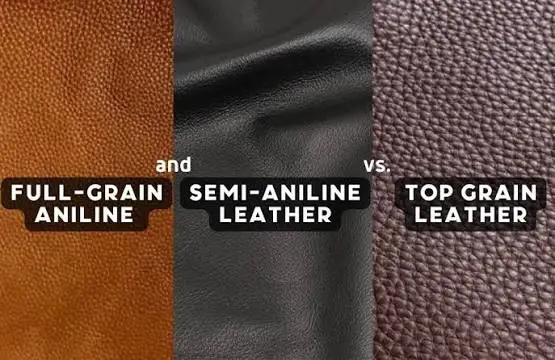
When comparing full-grain vs top-grain leather jackets, the label describes the leather’s grain surface, but it does not tell you everything about the finished jacket. Finish, thickness, tanning, lining, construction, and fit also affect how a jacket looks and feels. The most useful choice is the one that matches your preferred appearance and how you plan to wear it.
Quick answer: Full-grain leather keeps its original grain surface without corrective mechanical treatment. “Top-grain” refers to the upper grain layer, but sellers use the term inconsistently; some products described as top-grain have a sanded or corrected surface. Ask the maker what the label means for that specific jacket.
In this guide
- What full-grain leather means
- What top-grain leather means
- Practical differences for jackets
- How to choose between them
- What to check before buying
- Frequently asked questions
What is full-grain leather?
Full-grain leather retains its original grain surface; the surface has not been removed by corrective mechanical treatment. Natural marks and variation may remain visible, although dye and finish can change how noticeable they are. The Leather Working Group’s glossary defines full-grain in terms of retaining the entire grain without corrective mechanical treatment.
For a jacket, full-grain can appeal to someone who likes a more natural-looking surface. It does not automatically mean that a garment is soft, heavy, waterproof, or long-lasting. Those qualities depend on the hide, tanning, thickness, finish, pattern, stitching, and care.
What is top-grain leather?
Top-grain generally refers to leather from the outer grain layer of a hide. In product listings, however, “top-grain” may be used broadly, and some sellers use it for leather whose surface has been lightly sanded or corrected to look more uniform. Because terminology varies, the name alone is not enough to identify the exact treatment.
Ask whether the grain is intact, whether it has been buffed or corrected, and what coating or pigment has been applied. A smooth, even finish may suit buyers who prefer a consistent appearance. It is not automatically inferior or superior; evaluate the actual material and the quality of the whole jacket.
Full-grain vs top-grain leather jackets: practical differences
| What to compare | Full-grain | Top-grain as commonly described in listings |
|---|---|---|
| Grain surface | Original grain retained without corrective mechanical removal | Outer grain layer; some listings may describe a corrected or sanded surface |
| Appearance | Natural marks and variation may show through the finish | May look more even if the surface has been corrected |
| Feel | Depends on hide, tannage, thickness, and finish | Depends on hide, correction, coating, and finish |
| How it ages | Changes with wear depend on the finish and use | Changes with wear depend on the finish and use |
| Care | Follow the maker’s instructions for that finish | Follow the maker’s instructions; do not assume the same conditioner works |
| Price | Varies with material, construction, and brand | Varies with material, construction, and brand |
These are not guarantees about performance. Leather descriptions and finishing practices differ, so ask for the product’s specific material details rather than inferring quality from a label.
Which should you choose?
Choose full-grain if you like visible natural character
Full-grain may suit you if you prefer a surface with natural variation and the seller can confirm that the grain remains intact. Review close-up product images, ask about the finish, and consider whether small marks or changes with wear will bother you.
Choose a corrected, smoother top-grain finish if you prefer a uniform look
A corrected surface may suit a buyer who wants a more consistent appearance. Ask how much the grain has been altered and what finish is used. Do not assume the leather will be more durable or easier to maintain without product-specific information.
Choose based on the whole jacket
For either option, check the jacket’s fit, lining, seams, zipper, pockets, material description, care instructions, and return terms. A leather label cannot make up for uncomfortable sizing or weak construction. Our leather jacket buying guide explains other details to review before ordering. For help choosing a silhouette, see our overview of types of leather jackets.
Questions to ask before buying
- Does “top-grain” mean the original grain is intact, or has the surface been corrected?
- What dye, pigment, coating, or finish has been applied?
- What are the leather thickness or weight and the lining material?
- How does the jacket fit over the layer I expect to wear?
- Which care products does the maker recommend for this finish?
- What are the return and exchange terms if the fit is wrong?
How finish and construction affect the choice
In a full-grain vs top-grain leather jacket comparison, the grain label is only one part of the specification. Two jackets with the same label can look and feel different because one may have a heavier pigment, a softer tannage, or a different lining. Ask what treatment the leather received and, if available, request close-up photos in natural light.
Construction details are separate from grain quality. Look at seam alignment, reinforcement at stress points, zipper operation, lining attachment, and whether the jacket’s cut allows movement. These details can affect everyday comfort and how well the garment suits your routine.
How to compare leather jacket listings online
- Read the full material description. Check the stated animal, grain layer, surface treatment, lining, and any coatings. If a term is unclear, ask the seller to explain it for that product.
- Compare measurements. Use a jacket you already own as a reference. Check chest, shoulder, sleeve, and body length, and allow room for the layer you plan to wear.
- Review several product photos. Look at close-ups of the surface, seams, cuffs, pockets, and lining. Lighting can make color and texture appear different, so photos are an aid rather than proof of material quality.
- Check care and returns before checkout. Make sure you understand the recommended care and can return or exchange the jacket if the fit or finish is not what you expected.
These steps are useful whether a listing says full-grain or top-grain. In the full-grain vs top-grain leather jackets decision, clear specifications and a comfortable fit are more useful than a broad promise about “premium” leather.
Which option fits your priorities?
If you enjoy natural surface variation and the seller confirms the grain treatment, full-grain may match your preference. If you prefer an even surface, ask whether a corrected finish is used and how it changes the appearance. If neither label is explained clearly, compare another listing or request details before buying. There is no need to choose by status or price alone.
For a broader checklist covering lining, hardware, fit, and seller policies, see our leather jacket buying guide.
Frequently asked questions
Is full-grain always better than top-grain?
No. Full-grain describes an intact grain surface. Top-grain is used inconsistently in product descriptions and may refer broadly to the outer layer or to a corrected surface. The better choice depends on the specific hide, finish, construction, fit, and the appearance you prefer.
Does full-grain leather last longer?
The label alone cannot predict a jacket’s lifespan. Hide selection, thickness, stitching, lining, hardware, frequency of wear, storage, and care all matter. Compare the jacket’s construction details and warranty instead of relying on the grain term alone.
Will full-grain leather develop a patina?
It may show changes with use, but the result depends on the leather and its finish. Pigments or coatings can affect how the surface changes. Ask the maker what to expect for that jacket.
How can I tell what kind of leather a jacket uses?
Read the full product specification and ask the seller whether the grain is intact or corrected and what finish was applied. A phrase such as “genuine leather” does not by itself describe the grain treatment or construction quality.
Is top-grain leather real leather?
Top-grain describes leather from the hide’s grain layer. Ask for the full material specification because marketplace terminology and finishing descriptions can vary.
Final take
In the full-grain vs top-grain leather jackets comparison, full-grain means the original grain surface is retained, while “top-grain” can be used in different ways by sellers. Confirm the surface treatment, then judge the jacket by its finish, fit, construction, care requirements, and return policy. Those details will help you choose more reliably than the label on its own.
For material terminology, see the Leather Working Group’s leather industry glossary.
