
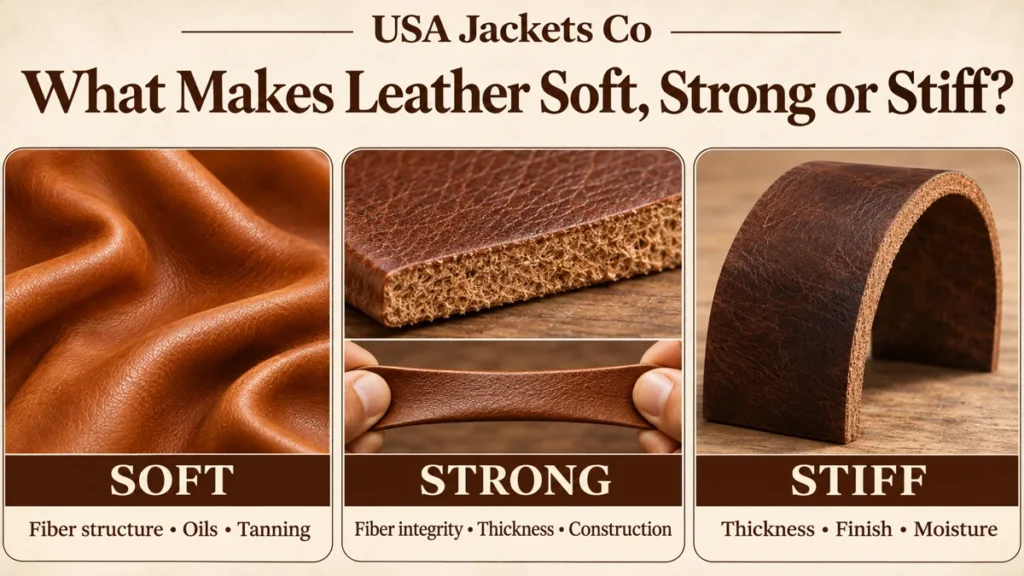
Leather can feel soft and fluid, firm and supportive, or almost board-like. These differences are not decided by one label. The feel of a leather jacket comes from several interacting choices: the animal hide, the part of the hide selected, its thickness, tanning and retanning, oils and lubricants used during processing, mechanical finishing, surface coating and the way the garment is built.
Softness describes how easily leather bends and drapes; strength describes how well it resists forces such as tearing, stretching and abrasion; stiffness describes how much it resists bending. They are related, but they are not the same measurement. A leather can feel supple while remaining suitable for a well-made garment, and a stiff leather is not automatically stronger.
This guide explains what makes leather soft, strong or stiff, how to compare jackets in person or online, and how to choose a feel that suits your intended use. If you are comparing material grades, start with our guides to full-grain leather and corrected-grain leather.
What does leather softness mean?
In everyday language, soft leather bends easily, feels flexible in the hand and tends to follow the shape of the body rather than holding a rigid outline. Leather professionals may describe this characteristic as its temper or hand. A soft temper usually feels pliable; a firm temper resists bending and holds more of its shape.
Temper is not a grade or a guarantee of quality. It is a property of the finished leather. Two hides from the same animal can be processed to feel quite different, and two jackets with the same broad material label may have different levels of softness.
What makes leather soft?
1. The animal hide and the area selected
Different species have different fibre structures, thickness ranges and natural characteristics. Lambskin is often selected for a light, supple garment, while cowhide is commonly chosen for a more substantial feel. Goatskin can have a distinctive grain and a balance of flexibility and body. These are broad tendencies, not rules: the individual hide, tannery process and final finish can change the result.
The part of the hide matters too. Areas of a hide do not have perfectly uniform fibre density or stretch. A maker selects and cuts panels with the intended garment in mind. Good selection helps keep the jacket balanced, while careless cutting can leave some panels feeling noticeably looser or more rigid than others.
2. Thickness and fibre structure
Thickness affects how leather bends, but it does not tell the whole story. A thicker hide often feels more substantial and may resist folding more than a thin hide of similar temper. However, a well-lubricated thick leather can still feel flexible, while a thin leather with a firm finish may feel surprisingly resistant.
For a jacket, the useful question is not simply “How thick is it?” Ask whether the thickness and flexibility suit the style. A close-fitting fashion jacket may need a different hand from a structured outer layer or a garment designed to carry substantial details.
3. Tanning and retanning
Tanning stabilises the hide so it can be used as leather. Different tanning systems and combinations can produce different characteristics. Chrome-tanned garment leather is often made with a supple hand, while vegetable-tanned leather is often firmer and more shape-holding. But tanning method alone does not determine the finished feel: retanning, lubrication, dyeing and later finishing all influence the outcome.
Some leathers are combination-tanned or receive additional processing to reach a target feel. If a product description names only the tanning method, it still leaves important questions unanswered about thickness, finish and temper.
4. Oils, fats and lubricants
During leather processing, lubricating materials are introduced to help the fibres move against one another rather than feeling dry and rigid. In the trade, this is often discussed as fatliquoring. The type and amount used can affect softness, flexibility and the way leather responds when bent.
Oil- or wax-rich finishes may also change the hand and surface character. Some feel supple and slightly waxy; others are firmer or develop visible colour variation when flexed. Do not assume that “oiled” always means soft. Ask about the finished feel of the specific leather.
5. Mechanical softening and finishing
After tanning, leather can be worked mechanically to adjust its feel. Processes such as staking, milling or tumbling help relax the material and can make it more pliable. The exact result depends on the leather and the process used.
Surface finishing matters as well. A heavy pigment or polymer coating can make the surface feel firmer and change how it folds. A lighter finish may leave more of the leather’s natural hand noticeable. Aniline, semi-aniline, waxed and pigmented finishes describe different approaches to colour and surface protection; none should be treated as a direct softness rating.
What makes leather strong?
Strength is the ability of leather to resist damage under particular conditions. Depending on the test, this may include tensile strength, tear resistance, seam strength, flex performance or abrasion resistance. These properties are not interchangeable, and a hand-feel test cannot measure them accurately.
The structure of the hide, the quality of tanning, the direction in which panels are cut, the thickness, the condition of the surface and the finishing process all contribute. Garment construction adds another layer: even good leather can be let down by weak stitching, poor seam placement, unsuitable thread or low-quality hardware.
For a buyer, a practical way to think about strength is to look beyond the shell label. Check the whole jacket: panel consistency, stitching at stress points, lining attachment, pocket construction, zipper operation and how the garment moves when worn.
Why can leather feel stiff?
Stiffness is resistance to bending. It can be intentional, especially when a maker wants a jacket to keep a defined shape, but it can also be a result of processing or an unsuitable material choice.
- Greater thickness: a heavier or thicker hide may naturally resist bending more than a lighter one.
- Firm temper: some leathers are processed to hold shape rather than drape loosely.
- Vegetable tanning: many vegetable-tanned leathers have a firmer hand, although the final result varies.
- Heavy surface coating: a thick finish can make the surface less flexible.
- Low lubrication or different retanning: the fibre structure may feel less pliable.
- Dryness or poor storage: leather that has been neglected or exposed to unsuitable heat may feel dry and less flexible.
- Construction choices: stiff interlinings, heavy padding or restrictive lining can make a jacket feel rigid even if the shell leather is supple.
A jacket that feels firm when new may relax somewhat with normal wear, depending on the leather and finish. Do not expect a rigid material to transform into a soft one, and do not try to force the process with heat, soaking or household oils.
Soft leather versus strong leather: is there a trade-off?
There can be trade-offs, but softness and strength are not opposite ends of one simple scale. A well-selected, well-processed leather can be both flexible and durable. A very soft leather may be more vulnerable to visible scratches or stretching in some finishes, while a firm leather may hold its shape but feel less comfortable for a close-fitting garment.
| Feel | Typical wearing impression | What to check |
|---|---|---|
| Very soft and drapey | Moves easily and follows the body. | Panel consistency, lining, seam quality and how the leather responds at elbows and shoulders. |
| Supple with some body | Flexible but still keeps a clear jacket silhouette. | Whether the jacket bends comfortably without feeling loose or flimsy. |
| Medium or balanced | Offers a mix of movement and structure. | Whether the weight and fit suit your climate and layering needs. |
| Firm and structured | Holds a more defined shape and may need a longer adjustment period. | Shoulder movement, arm reach, closure comfort and whether the stiffness is intentional. |
| Very rigid | Resists bending and may feel restrictive in a garment. | Whether it is appropriate for the design; do not assume rigidity means superior strength. |
How to choose the right feel for a leather jacket
For a close-fitting fashion jacket
Look for leather that bends comfortably across the chest, shoulders and elbows. A supple hand can help a fitted silhouette move with you, but the jacket should not feel limp or lose its shape. Check the lining too, because a tight or bulky lining can restrict movement even when the leather is soft.
For a classic everyday jacket
A medium, balanced temper is often a practical starting point. It can provide enough structure for a defined shape without making the jacket feel unnecessarily rigid. Consider how you will wear it: over a T-shirt, over a knit, or over a heavier layer.
For a rugged or structured style
A firmer leather may suit a jacket with a more substantial appearance. The key is proportion. Make sure the shoulders sit correctly, the sleeves allow you to bend your arms, and the front closes without excessive pulling. A firm jacket should still be wearable, not painful or restrictive.
For suede or nubuck
These materials have a napped surface and can feel different from smooth finished leather. Their softness depends on the hide and finishing process. They also need care appropriate to the nap. Read our nubuck vs suede guide before choosing a textured finish.
How to assess leather softness when shopping
If you can handle the jacket in person, use gentle checks rather than pulling or twisting it aggressively:
- Lift the jacket by the shoulders. Notice whether it hangs naturally or keeps a very rigid shape.
- Gently bend a loose section. The leather should flex without a brittle feel or an unusually hard crease.
- Compare different panels. The sleeves, front and back should feel appropriate for the design and reasonably consistent.
- Move your arms. Reach forward, bend your elbows and sit down. Check for restriction across the back and shoulders.
- Feel the lining and seams. The complete garment determines comfort, not the shell alone.
- Inspect the surface. Look for peeling, cracks, loose coating or damage rather than mistaking these for normal firmness.
When shopping online, request clear material details and close-up photographs. Ask for the hide type, leather grade, finish and approximate thickness if available. A product page that identifies the material more specifically is more useful than one that says only “premium leather”. For example, compare the material descriptions on The Alexander Jacket and the Charlie Jacket; they identify different leather materials, which is a starting point for asking about the intended hand and care.
Can a stiff leather jacket be softened?
Some stiffness may ease through ordinary, gentle wear as the leather flexes at natural movement points. The amount of change depends on the hide, tanning and finish. A jacket that is intentionally firm may remain structured.
Avoid soaking the jacket, applying cooking oil or household moisturisers, using a hairdryer or placing it near a heater. These methods can stain, distort or dry the leather and may damage the finish. If the jacket feels unusually dry, has developed hard creases or needs a substantial change in feel, ask a leather-care professional who can assess the specific material.
For a new jacket, follow the care instructions supplied with it. If you are considering a made-to-order piece, discuss the desired softness and structure before production through the custom leather jackets service. A clear reference sample or description such as “soft and drapey”, “supple with structure” or “firm and shape-holding” is more useful than simply asking for “the softest leather”.
Frequently asked questions
Does thicker leather always mean stronger leather?
No. Thickness can contribute to substance and resistance to bending, but strength also depends on fibre structure, tanning, hide selection, finish and construction. Thickness alone is not a complete quality test.
Is soft leather lower quality?
No. Softness is a characteristic, not a quality grade. A supple leather can be well made and suitable for a jacket. Check the material, panel selection, seams, lining and hardware rather than judging by softness alone.
Why is my new leather jacket stiff?
It may have a firm temper, a heavier hide, a particular tanning or finishing process, or a structured lining. Some materials relax slightly with normal wear, but a very rigid jacket may remain firm. Check that the fit allows comfortable movement.
Does leather get softer with age?
It may become more pliable in areas that flex regularly, but the amount varies. Ageing, care, moisture exposure and finish all influence the result. Softening is not guaranteed and should not be forced with heat or unsuitable oils.
Which leather is softest for jackets?
Some lambskin and nappa leathers are selected for a soft, supple feel, but there is no universal answer. Thickness, tanning, lubrication and finishing can make two examples of the same hide type feel different.
Can strong leather still be flexible?
Yes. Flexibility and strength are separate properties. The goal is to choose a leather and construction that balance movement, shape and the type of wear you expect.
Final takeaway
Leather softness, strength and stiffness come from the complete manufacturing process, not from a single label or thickness figure. Choose a hand-feel that suits the jacket’s silhouette and your routine, then check the construction and fit just as carefully as the material. The most useful product description explains the hide, grade, finish and intended feel clearly.
