
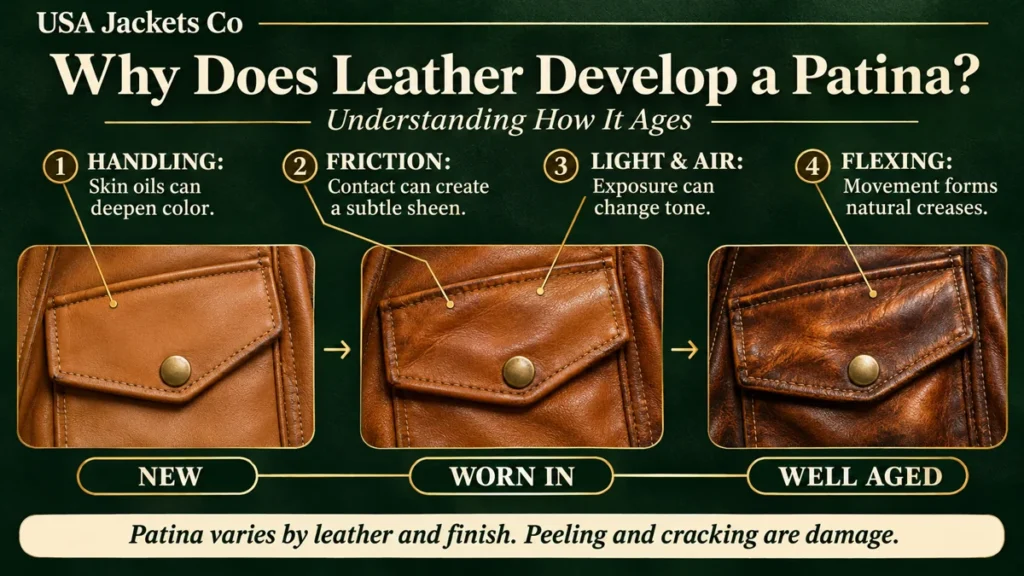
A leather patina is the gradual change in a leather item’s appearance as it is handled, worn and exposed to its surroundings. It may show as a soft sheen, deeper colour in frequently touched areas, subtle tonal variation, gentle creasing or burnished edges. Rather than appearing as a perfectly uniform finish, the leather begins to reflect how it has been used.
Patina is often discussed as a sign of character, but it is not a guarantee of quality and it does not mean every mark is desirable. The way leather ages depends on the hide, tanning and finishing methods, colour, care routine and conditions of use. Understanding those factors helps you decide whether you want a jacket that develops visible character or one that keeps a more consistent appearance.
What is leather patina?
Patina is a gradual surface and colour change that develops over time. On leather, it can include a mellowing of the original shade, a soft polish where the material is repeatedly touched, and small differences between high-contact and less-used areas. It is usually the combined result of handling, friction, light exposure, natural oils, dust and the way the leather finish responds to use.
There is no single colour or pattern that defines patina. A brown jacket may become richer or darker in some areas; a black jacket may develop a subtle sheen along the sleeves and edges; a lighter leather may show changes in tone more clearly. The result depends on the original material and finish.
Why does leather develop a patina?
1. Repeated handling and contact
Everyday contact changes the surface gradually. Areas such as the collar, cuffs, pocket openings, elbows and front edges are handled more often than the centre of the back. Repeated contact can polish the surface or change how light reflects from it. Natural oils from skin may also influence the appearance, particularly on leather with a more open or transparent finish.
2. Friction and movement
Leather flexes as you move. Sleeves bend at the elbows, the body creases when you sit, and edges rub against bags, seat belts or other clothing. With time, these repeated movements can create softer creases and subtle changes in surface sheen. Gentle, gradual wear is different from deep abrasion that cuts through the finish or damages the leather.
3. Light and the surrounding environment
Light exposure can contribute to colour change. Direct sunlight and strong ultraviolet exposure may fade or alter some dyes and finishes, while indoor light can also affect certain materials over long periods. Humidity, airborne dust and contact with other surfaces can influence the way a jacket ages. These effects are not always attractive, so patina should not be treated as a reason to leave leather in harsh conditions.
4. The leather’s finish and colour
The finish determines how much of the natural surface remains visible and how easily everyday contact changes its appearance. Transparent finishes tend to reveal more of the leather’s grain and tonal variation. Heavier pigment or protective coatings create a more uniform surface and can make gradual changes less noticeable. The original colour matters too: a light tan may show darkening and handling marks more clearly than a deep black.
Which leather develops the most visible patina?
Leather that retains a natural-looking surface often shows the most obvious visual evolution. However, the finish is just as important as the grain category.
| Leather or finish | Typical ageing appearance | What to consider |
|---|---|---|
| Full-grain leather | Natural grain, small marks and tonal changes may remain visible as the surface ages. | Full-grain describes the grain layer retained; the finish still affects how much patina you see. |
| Aniline leather | Often shows colour variation and handling changes clearly because the colour is transparent. | It may show stains, scratches and fading more readily, so care and storage matter. |
| Semi-aniline leather | May develop some character while retaining a more controlled surface appearance. | The level of pigment and protection varies between products. |
| Pigmented leather | Usually keeps a more consistent colour; changes may appear mainly as wear to the coating or surface sheen. | A uniform appearance can be easier to maintain, but coating damage is not patina. |
| Suede and nubuck | The nap can become smoother or darker in high-contact areas. | Changes in the nap are different from the glossy patina often seen on smooth leather. |
Full-grain leather is often associated with patina because its natural grain is retained, but it is inaccurate to say that only full-grain leather can age or develop character. Top-grain leather, suede and other genuine leather types also change with use; the changes may simply look different or be less visible because of their surface treatment.
Patina versus damage: how to tell the difference
Patina is usually gradual and follows the way an item is handled. Damage tends to be more abrupt, localised or structurally concerning. The distinction is important because a mark that looks like character may actually need attention.
- Possible patina: a gradual soft sheen on frequently touched areas, gentle colour variation, mild burnishing or natural creases that do not split the surface.
- Possible damage: flaking or peeling finish, cracks that expose the layer beneath, deep scratches, sticky areas, severe colour transfer, water tide marks or a musty smell.
- Possible staining: a distinct spot or ring caused by oil, food, ink, dye transfer or moisture. A stain is not automatically patina.
If the finish is lifting, the leather is cracking or a stain is spreading, do not assume it will improve with age. Avoid rubbing the area aggressively or covering it with polish. Ask a leather-care professional or the seller to assess it.
Does patina make leather stronger or more durable?
Patina is primarily an appearance change. It does not automatically make leather stronger, waterproof or more resistant to abrasion. A jacket’s durability depends on the leather’s quality and thickness, the condition of its fibres, the construction, stitching, lining, hardware and how it is used and maintained.
A well-cared-for jacket can develop attractive character while remaining wearable, but cracks, brittle areas and peeling finishes are not signs of improved durability. Think of patina as a record of use, not a performance rating.
How long does it take for leather to develop patina?
There is no fixed timetable. Some lightly finished leather goods show visible changes after regular use over a relatively short period; other jackets may look much the same for years. The pace depends on how often the jacket is worn, where it experiences friction, the environment, the colour and the finish.
A jacket worn every week will usually experience more handling and movement than one kept for occasional events. Even two people wearing the same model can create different patterns because their habits, climate and storage conditions are different.
Can you encourage a natural patina?
The safest way is simply to wear and enjoy the jacket in normal conditions, then care for it according to its finish. There is no reliable shortcut that improves every type of leather. Applying extra oil, leaving a jacket in direct sun, repeatedly wetting it or rubbing it with abrasive materials can cause uneven darkening, stains, stiffness or finish damage.
If you like the look of aged leather, choose a jacket whose material and finish are expected to show natural variation. Ask the maker whether the surface is aniline, semi-aniline, waxed, distressed or heavily pigmented, and request close-up photographs where possible. The phrase “vintage look” can describe a factory-applied finish rather than natural ageing, so clarify whether the effect is already present when the jacket arrives.
How to care for a leather jacket while it ages
Good care does not have to erase patina. It helps prevent avoidable damage while allowing normal wear to happen.
- Brush or wipe away surface dust gently. Use a clean, soft cloth for smooth leather. Use a suitable suede brush for suede or nubuck rather than a damp cloth unless the care instructions say otherwise.
- Deal with spills promptly. Blot rather than scrub. Do not spread an oil or liquid stain by rubbing it across the surface.
- Let wet leather dry naturally. Keep it away from radiators, hairdryers and direct heat. Do not store it while damp.
- Condition only when appropriate. Use a product compatible with the specific leather and finish. Test it on a hidden area first; too much conditioner can darken or soften leather unevenly.
- Store it with support. Use a broad, sturdy hanger and allow air circulation. Avoid long-term compression in a plastic bag or an overcrowded wardrobe.
- Seek professional help for serious marks. Ink, dye transfer, deep stains, peeling or cracking may need specialist treatment.
USA Jackets Co provides care directions on individual product pages, and those instructions should take priority over general advice. For example, some jackets specify professional or soft dry cleaning rather than home washing. You can also review the brand’s jacket-making process and the options described on its custom leather jackets page when comparing leather types and finishes.
What to look for if you want a jacket that ages gracefully
Before buying, look beyond the words “genuine leather” or “vintage leather.” Ask for the details that affect how the jacket will look after regular wear:
- What animal hide and leather grade are used?
- Is the finish aniline, semi-aniline, pigmented, waxed, distressed or another treatment?
- How much natural grain and variation should be visible?
- Does the colour tend to darken, lighten or develop a sheen with handling?
- What care products are approved for this finish?
- Can the seller provide close-up photographs or a sample of the actual leather?
If you prefer a jacket that keeps a consistent appearance, a more uniform pigmented finish may suit you. If you enjoy visible changes and natural variation, a lightly finished leather may be more appealing. Neither preference is more correct; the right choice is the one that matches your expectations and willingness to care for it.
Frequently asked questions
Does every real leather jacket develop a patina?
Genuine leather can change with age and use, but the amount and appearance vary. Some finishes show subtle changes, while heavily coated surfaces may remain more uniform until the coating itself wears.
Does only full-grain leather develop patina?
No. Full-grain leather often shows natural variation, but other leather types can also change. The finish, surface coating and use conditions influence how visible those changes are.
Is a darker leather jacket always more likely to develop patina?
No. Colour affects how changes are seen, but it does not determine the entire process. A light leather may show darkening or marks clearly, while a dark leather may show polishing and sheen.
Can I use oil to make my leather jacket develop patina faster?
It is not recommended as a general shortcut. Oils can darken leather unevenly, affect the finish or leave stains. Use only products approved for your particular jacket and follow the care instructions.
Is cracking a type of patina?
No. Cracking usually indicates that the surface finish or leather has become damaged or dried out. It should not be treated as a desirable ageing effect.
Can I remove patina from a leather jacket?
Some surface marks can be cleaned, but natural colour and sheen changes may not be reversible. A professional can assess whether cleaning or refinishing is appropriate without causing further damage.
Final takeaway
Leather develops patina because its surface responds gradually to handling, movement, light and its surroundings. The effect is most visible on some natural-looking finishes, but it is not exclusive to one leather grade and it does not prove that a jacket is durable. Choose a finish that suits the appearance you want, follow care guidance for that specific material and let normal wear happen without trying to force it. A jacket that ages well is one that remains in good condition as its appearance becomes more personal.
