
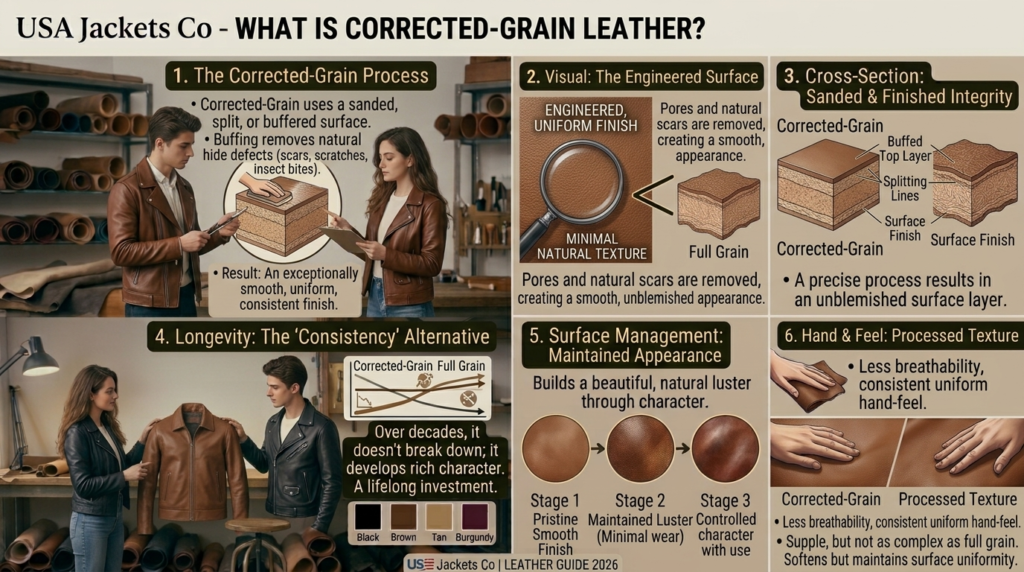
Corrected-grain leather is leather whose outer surface has been altered to create a more even appearance. The surface may be buffed or sanded, then finished with pigment, embossing, or another treatment. The exact process varies, so the label alone cannot tell you precisely how the material will look or feel.
For jacket buyers, corrected-grain can be useful when a consistent color and pattern are priorities. It also raises practical questions: how much has the surface been changed, what finish is on it, and how does the complete jacket fit your needs? This guide answers those questions without treating a single label as a quality verdict.
What “corrected grain” means
Leather begins as an animal hide that is tanned and finished. If the outer surface has marks or uneven areas, a tannery may refine it by buffing or sanding. A finish can then even out the color or appearance. Some leathers are embossed with a grain pattern to create a regular texture. Sellers may use “corrected-grain” to describe leather treated in these ways, but terminology and production details can differ.
The key point is that corrected-grain is still leather. The name describes surface treatment, not whether a material is synthetic. It also does not specify every detail about the hide, tanning, thickness, coating, or jacket construction. Ask for a plain explanation of the material rather than relying on one term.
Why is leather corrected?
Natural hides vary. Marks, scars, insect bites, and differences in grain can make the surface less uniform. Refining and finishing can produce a more consistent appearance across panels, which can be desirable in a garment where matching color matters. Embossing can also provide a regular texture.
For the person wearing the jacket, the appeal is often visual and practical: a clean, repeatable finish that looks similar from one section to another. A smooth or pigmented finish may also make minor surface variation less noticeable. Those traits depend on the particular leather and finish, so inspect the jacket’s own description and images.
Corrected-grain compared with full-grain and top-grain
These terms describe different aspects of the surface. Full-grain generally means the natural outer grain is retained without sanding it away. Top-grain refers to leather from the outer layer that is commonly refined. Corrected-grain emphasizes that the surface has been altered to address marks or variation, often with further finishing or an embossed pattern. In industry and retail descriptions, use is not always perfectly consistent.
| Term | What it generally signals | What it does not tell you |
|---|---|---|
| Full-grain | Natural outer grain retained without sanding it away | Exact finish, softness, weight, or jacket construction |
| Top-grain | Outer-layer leather whose surface is commonly refined | How much refinement or what finish is used |
| Corrected-grain | Surface altered to make appearance more uniform, potentially including embossing or pigment | Exact grade of every panel, coating details, or overall garment quality |
Because some sellers use overlapping language, the most helpful product description states the shell material, finish, and any embossing separately. If a listing only says “premium leather,” request specifics.
Potential benefits for a jacket
- Consistent appearance: Refining and finishing can reduce visible differences between panels.
- Available in many looks: Pigments and embossed patterns can create a range of colors and textures.
- Useful for a polished style: A uniform surface may work well for a streamlined bomber, racer, or other clean silhouette.
- Marks may be less prominent: Surface treatments can make some natural irregularities less visible.
These are possible characteristics, not guarantees. A thin coating, a heavy finish, or a particular embossing can change how a jacket feels and ages. Look at the exact product rather than assuming every corrected-grain leather behaves alike.
Trade-offs to understand
Surface correction can make the natural grain less visible. Buyers who specifically want an organic, varied grain may find that less appealing. A more uniform surface also does not mean the material is automatically more durable or easier to maintain. The finish is part of the care equation, and unsuitable cleaners or conditioners can affect it.
Some corrected surfaces include a more pronounced pigment or embossing. If you care about texture, flexibility, or how the jacket will develop character, ask how the surface is finished and whether the maker recommends any special precautions. A responsible description should avoid promising that a jacket is scratch-proof, waterproof, or maintenance-free without evidence.
How to inspect corrected-grain leather online
- Read the material statement carefully. Identify what is used for the shell and whether trim, panels, or the lining differ.
- Look for finish details. Is it pigmented, embossed, matte, glossy, or described in another specific way?
- Compare multiple photos. Check close views and full-length images in different lighting. A single product image may hide texture.
- Check how the surface bends. If a video or in-person inspection is available, observe whether the leather flexes naturally at the elbows and body.
- Read the care directions. Follow guidance for the exact finish and ask the seller if it is unclear.
- Review fit and return terms. Material selection cannot compensate for a jacket that restricts movement or cannot be returned under your circumstances.
How to judge the whole jacket
Leather grade is one line in a product evaluation. Check the shoulder position, sleeve length, torso room, and whether the jacket works with the layers you expect to wear. Inspect the zipper and snaps, pocket placement, seam quality, lining, and the weight of the garment. On a listing, confirm the size chart and compare its measurements with a jacket you already own that fits well.
Think about the setting too. A refined, uniform finish may suit a jacket you plan to wear to work or with simple everyday outfits. If you want a piece whose natural grain is prominent, look for descriptions and photographs that show that quality. A motorcycle jacket also needs purpose-built protective features; a fashion jacket’s leather grade by itself does not establish riding protection.
USA Jackets Co’s buying guide offers broader checks on fit and construction. You can also review full-grain leather for a related surface comparison and browse the custom jacket leather options to see how material choices can be specified.
Questions worth asking the seller
- What do you mean by corrected-grain for this specific jacket?
- Has the surface been sanded or buffed, and is it embossed?
- What type of finish or pigment is applied?
- Is the same leather used across the full shell?
- What products or cleaning methods should I avoid?
- Can you provide close-up photos of the actual finish?
FAQs
Is corrected-grain leather real leather?
Yes. The term generally describes leather whose surface has been altered or refinished. It is distinct from synthetic leather, although a listing should clearly identify the shell material.
Is corrected-grain lower quality?
Not necessarily. Surface correction describes processing, not the whole quality of a jacket. Hide selection, thickness, finish, construction, fit, and quality control also matter.
Is corrected-grain the same as top-grain?
The terms can overlap in retail descriptions, but they do not always mean the same thing. Top-grain identifies leather from the outer layer that is commonly refined; corrected-grain highlights alteration to the surface. Ask the seller to define the term for that product.
Does corrected-grain leather have a printed pattern?
Some corrected leathers are embossed with a regular grain pattern, while others are finished without a pronounced embossing. Check the product images and description.
How should I care for a corrected-grain jacket?
Use the care instructions supplied for the particular jacket. A finish may react differently to cleaners and conditioners, so avoid experimenting with household products or applying treatment without checking suitability.
Can corrected-grain leather develop patina?
It may change with wear, but the amount and character of change depend on the finish. A coated or strongly pigmented surface can age differently from leather with a more open, natural finish.
Choose by finish, fit, and construction
Corrected-grain leather can provide a more consistent surface and a wide choice of finishes. Its value depends on the leather and the garment, not on the label in isolation. Ask what surface work was done, inspect close-up photos, learn the care requirements, and compare the fit and construction. That gives you a grounded basis for choosing a jacket whose appearance and everyday use match your expectations.
