
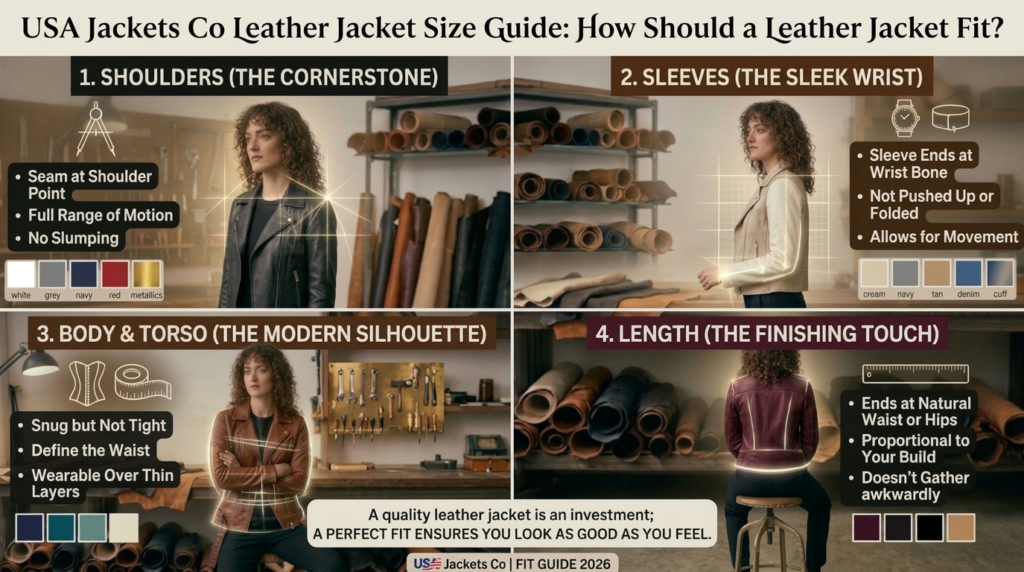
A leather jacket should feel secure at the shoulders and chest, allow you to move naturally, and leave enough room for the layers you plan to wear underneath. It should not pull sharply across the back, force the sleeves up when you reach forward, or hang so loosely that the shape disappears. The right size depends on your body measurements, the jacket’s cut, its lining, and how you intend to wear it.
This leather jacket size guide explains how to measure yourself, read a size chart, check the fit of different styles, and avoid common online-sizing mistakes. Use it alongside the USA Jackets Co Size Guide and the measurements listed on the specific product you are considering.
Quick Answer: How Should a Leather Jacket Fit?
- Shoulders: The shoulder seams should sit close to your natural shoulder points, unless the design is intentionally dropped or oversized.
- Chest: You should be able to zip or fasten the jacket without strained seams or strong horizontal pulling.
- Arms: You should be able to bend your elbows, reach forward, and lift your arms without the jacket becoming painfully restrictive.
- Sleeves: On most standard styles, sleeves finish around the wrist bone when your arms are relaxed.
- Body length: Many classic biker and racer jackets finish around the waistband; bombers and longer fashion cuts can differ.
- Room for layers: Choose enough space for the shirt, knitwear, or mid-layer you realistically plan to wear.
A leather jacket may soften and relax slightly with wear, depending on the leather and construction, but it should not be painfully tight when new. Do not buy a size that restricts movement on the assumption that it will stretch into a perfect fit.
1. Check the Size Chart Before Choosing a Size
Never rely on the letter size alone. An M or L is not identical across every brand, country, or jacket design. A fitted racer, a relaxed bomber, and a lined aviator jacket can have very different proportions even when their labels show the same size.
Start with the size chart on the product page. Check whether it lists body measurements or garment measurements:
- Body measurements describe the person the size is intended to fit. The jacket needs additional room, often called ease, so you can move and layer.
- Garment measurements describe the jacket itself. Its chest circumference will normally be larger than the body measurement it is designed to accommodate.
Do not compare a body measurement directly with a garment measurement as if they were the same. If the chart does not explain which type it uses, contact the seller before ordering. Also check the chart for that particular product rather than assuming every style uses the same pattern.
2. Measure Yourself Accurately at Home
Use a flexible measuring tape, stand naturally, and ask someone to help if possible. Keep the tape level and comfortably snug; pulling it tight can produce a measurement that leads you to choose a jacket that is too small. Record measurements in centimetres or inches and use the same unit as the chart.
Chest
Wrap the tape around the fullest part of your chest, passing it under your arms and across your shoulder blades. Breathe normally and keep the tape horizontal. This is often one of the most useful measurements for selecting a jacket size, but it does not replace checking the shoulders and sleeves.
Shoulders
Measure across the back from one shoulder point to the other, following the method shown by the seller. Shoulder measurements can be difficult to take alone. If the chart does not provide body shoulder measurements, measure a jacket you already own that fits well and compare it only with garment measurements supplied in the same way.
Sleeve length
With your arm relaxed and slightly bent, measure from the shoulder point down to the wrist bone. Check whether the seller measures from the shoulder seam or from the centre back, because these methods produce different numbers. A sleeve measurement is useful only when you know how it was taken.
Waist and body length
Measure around your natural waist if the chart requests it. For body length, note where you want the hem to sit, then measure from the base of the neck or the shoulder point according to the chart’s stated method. Jacket length is especially important if you have a longer or shorter torso than average.
Measure a jacket you already like
Lay a well-fitting jacket flat on a clean surface, smooth it without stretching it, and measure its chest width, shoulder width, sleeve, and back length. Double the flat chest width only if the seller’s chart asks for circumference. Compare like with like: a jacket measured flat should not be compared directly with a body-circumference chart.
3. Check These Five Areas When You Try It On
Shoulders and upper back
The shoulder seam should usually sit near the point where your shoulder turns into your upper arm. A seam that falls far down the arm can make a standard-fit jacket look too large; a seam that sits too high can pinch. Some bomber and oversized designs intentionally use dropped shoulders, so judge the result against the intended silhouette.
Move your arms forward as if you were holding a steering wheel. Mild resistance can be normal in a close-fitting leather garment, but sharp pulling across the back or seams under strain suggests the cut or size may be wrong.
Chest and front closure
Zip or fasten the jacket in the way you expect to wear it. The front should lie reasonably flat without the zip bowing, the lapels pulling apart, or strong horizontal creases stretching from the closure. You should be able to breathe comfortably and sit down without the chest becoming restrictive.
Armholes and movement
Raise your arms, reach forward, bend your elbows, and turn your upper body. The jacket should move with you without digging into the armpits or forcing the whole body hem far upward. A low armhole can feel roomy when standing but may pull the entire jacket when you reach; a very tight armhole can restrict movement.
Sleeves and cuffs
With your arms relaxed, standard sleeves often end near the wrist bone. Some riders and fashion styles use a little extra length to account for arm position. Check the cuff opening too: it should accommodate your wrist and any intended watch or glove arrangement without flapping excessively or cutting into your arm.
Hem, waist and overall length
Classic biker and café racer jackets commonly sit around the waistband. Bomber jackets often finish at the waist with a ribbed hem, while aviator and shearling designs may be longer for added coverage. The correct length is the one that suits the design and your proportions without bunching uncomfortably when you sit.
4. Fit Depends on the Jacket Style
| Style | Typical fit | What to check |
|---|---|---|
| Biker | Close and shaped, often with an angled front | Chest closure, shoulder movement, lapel position, and sleeve length when reaching forward. |
| Café racer | Clean, streamlined silhouette | Enough room to zip comfortably without excess fabric bunching at the waist or back. |
| Bomber | Relaxed through the body with a defined hem | Whether the hem sits comfortably and the ribbing does not ride up or squeeze. |
| Aviator or shearling | Often more substantial, with a warm lining | Room for the lining and planned layers; do not size from an unlined jacket comparison alone. |
| Oversized fashion jacket | Intentionally roomy, sometimes with dropped shoulders | Whether the extra volume looks deliberate rather than simply too large, especially at the sleeves and hem. |
Use the style as context, not as a reason to ignore the chart. For example, a slim racer should not be expected to fit like a relaxed bomber. If you are still deciding which cut suits your routine, read our guide to leather jacket styles for first-time buyers.
5. Account for Layers, Lining and Weather
Think about when you will wear the jacket most. If it is mainly for mild weather over a T-shirt, a close fit may be comfortable. If you expect to wear a sweater underneath, test the size with a similar layer in mind. Do not add so much extra room that the jacket loses its shape just to accommodate a thick garment you rarely wear.
Lining also changes how a jacket feels. Quilting, fleece, or shearling can take up more space than a light fabric lining. A heavier leather may feel less flexible at first than a softer, lighter hide, but leather type alone does not determine the correct size. The pattern, lining, seam placement, and intended fit all matter.
6. What If You Are Between Sizes?
Do not automatically size up or down. Use the measurements and the fit you want to achieve:
- If your chest fits but shoulders are too wide: A smaller size may make the chest tight. Look for a different cut rather than forcing a poor shoulder fit.
- If shoulders fit but the chest pulls: Try the next size or a cut with more chest room, then recheck sleeve and body length.
- If you plan to layer: Choose the size that accommodates your normal mid-layer without stressing the closure or seams.
- If the chart is unclear: Ask the seller which measurement matters most for that style before purchasing.
- If the sleeves or torso are unusually long or short on you: Check whether alterations are practical. Shoulder and armhole changes can be more complicated than simple sleeve shortening.
7. Common Leather Jacket Fit Problems
| Problem | Likely cause | What to do |
|---|---|---|
| Zip strains or front panels pull apart | Insufficient chest or waist room, or a cut that does not suit your proportions | Recheck measurements and consider a larger size or different pattern. |
| Shoulder seam hangs far down the arm | Size too large or an intentionally oversized design | Compare with the product’s intended silhouette before sizing down. |
| Jacket rides up dramatically when reaching | Restricted upper-back or armhole movement, or sleeves cut too short for the activity | Test movement again and ask about the cut; do not judge by chest size alone. |
| Sleeves cover most of the hands | Sleeves too long or a style designed for a different arm position | Check the stated sleeve measurement and alteration options. |
| Hem bunches when sitting | Body length, waist shape, or style may not suit your proportions | Compare the jacket’s back length with one you already wear comfortably. |
| Jacket feels tight over a sweater | Size chosen for a T-shirt rather than the intended layers | Reassess the layer you will actually wear; avoid forcing the closure. |
8. A Simple Checklist for Buying a Leather Jacket Online
- Measure your chest, shoulders, sleeves, and any other dimensions required by the chart.
- Confirm whether the chart shows body measurements or garment measurements.
- Open the product’s own size chart and check its measurement method.
- Compare the jacket length and sleeve length with a jacket you already like.
- Choose based on the intended silhouette and the layers you will wear.
- Read the product details for lining, closure, and fit notes.
- Review the seller’s delivery, return, and exchange conditions before paying.
- Contact the seller if your measurements fall between sizes or the chart leaves a key question unanswered.
Explore the men’s jacket collection or the women’s jacket collection after taking your measurements. For broader buying advice, see the leather jacket buying guide. Use the product information and sizing details to make the final decision rather than choosing by the photo or letter size alone.
Frequently Asked Questions
Should a leather jacket feel tight at first?
It can feel structured or less flexible than a soft fabric jacket, but it should not cause pain, restrict breathing, strain the zip, or prevent normal movement. Do not rely on dramatic stretching to correct a jacket that is clearly too small.
Where should leather jacket sleeves end?
For many standard casual styles, the sleeves finish near the wrist bone when your arms are relaxed. The ideal length can vary with the design and how you position your arms, so use the product’s measurement method and intended use.
Can a leather jacket be altered if it does not fit?
Some alterations, such as modest sleeve shortening, may be possible with an experienced leather tailor. Shoulder, armhole, lining, and zip changes can be more involved and costly. Check alteration feasibility before buying rather than assuming every fit issue can be fixed.
What should I do if I am unsure about my size?
Compare your measurements with the current product chart and ask the seller for help if the chart is ambiguous or your measurements fall between sizes. Include your chest, shoulder, sleeve, and preferred layering details so the recommendation is based on the fit you want.
Final Takeaway
The best leather jacket size is the one that fits your shoulders and chest, lets you move naturally, and works with the layers you intend to wear. Measure carefully, read the product-specific chart, and assess the sleeves, length, and closure as a complete fit. A few minutes spent checking these details before ordering can help you choose a jacket that feels comfortable and looks intentional for years to come.
