
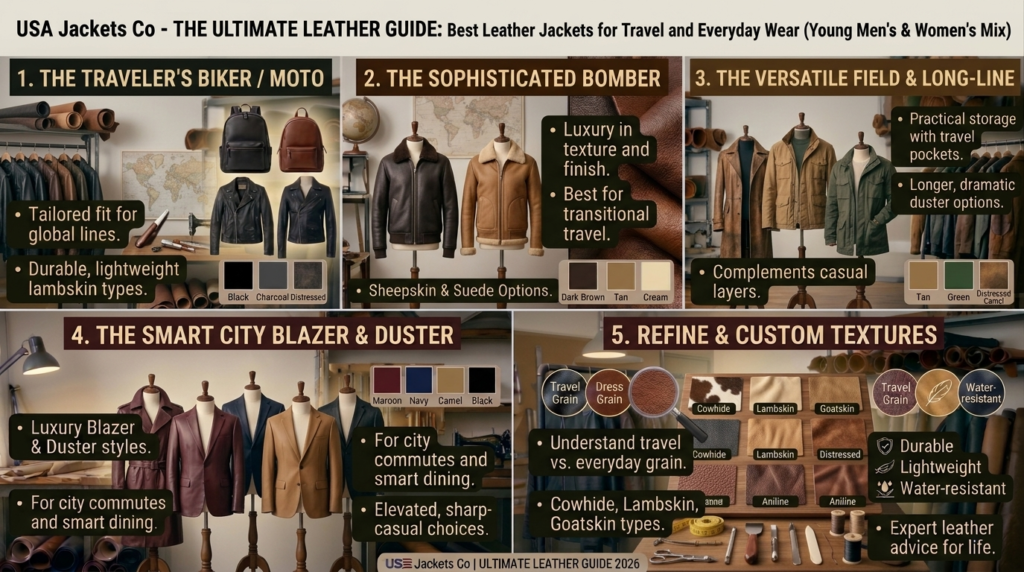
The best leather jackets for travel and everyday wear are versatile enough for a normal day at home and practical enough to take on a trip. That usually means a comfortable fit, a weight you can wear for hours, a color that works with several outfits, and a design that layers without becoming bulky. A jacket that looks good in a product photo but feels heavy on a train, tight across the shoulders, or difficult to pair with your clothes is unlikely to become a true travel staple.
This guide helps you choose a jacket for commuting, city breaks, weekend trips, and daily errands. It covers silhouettes, leather types, packing, weather, and outfit combinations without assuming one design is right for everyone.
What makes a jacket travel-friendly?
For travel, versatility is more useful than a long list of decorative features. Look for a jacket that earns its place in your bag—or that you can comfortably wear during the journey—by working with several items you already plan to pack.
- Comfort over time: the shoulders, elbows, and back should remain comfortable when sitting, walking, and reaching for luggage.
- Manageable weight: heavy leather and thick insulation can be useful in cold conditions but tiring in warm terminals or on long journeys.
- Easy outfit matching: black, dark brown, and some mid-brown shades can coordinate with denim, chinos, knitwear, and simple dresses.
- Useful pockets: pockets should hold everyday items securely without creating uncomfortable bulk. Keep passports, tickets, and valuables secure according to your travel needs.
- Practical layering: there should be enough room for the layer you intend to wear underneath, without making the jacket look oversized when worn alone.
- Care expectations you can manage: choose a finish you are willing to protect from moisture, stains, and rough handling.
Which jacket style works best?
1. A clean racer for a compact wardrobe
A racer jacket has a streamlined shape and usually fewer details than a traditional biker. It is a strong option if you want one jacket for jeans, chinos, plain shirts, and lightweight knitwear. Its cleaner front can also work for a casual dinner or a smart-casual day out. Choose black for a sharper contrast or brown for a softer palette.
For travel, check how the collar sits when you carry a backpack or shoulder bag. Make sure the jacket does not rub uncomfortably at the neck or restrict your arms when you reach overhead.
2. A bomber for relaxed daily use
A leather bomber is a natural fit for casual wardrobes built around T-shirts, denim, trainers, and knitwear. Ribbed cuffs and a hem give it a relaxed outline, while the leather adds structure. A lighter bomber can be useful during mild weather; a lined or insulated version may suit colder destinations but take up more space.
Try the jacket with the thickest layer you realistically expect to wear beneath it. If the hem rides up or the shoulders feel tight when you reach forward, it may not be the best choice for long days in transit.
3. A simple biker for a more distinctive look
A biker jacket adds personality to basic travel clothes and can work from daytime sightseeing to an informal evening meal. The angled zip and hardware are visually strong, so it is often easiest to style with plain tops and uncomplicated trousers. A less embellished version is easier to repeat across several outfits.
Extra belts, studs, and metal details may add character, but think about their weight and whether they catch on scarves or bag straps. Choose details because you like them, not because a travel jacket needs to look rugged.
4. A longer coat for colder destinations
A longer leather coat can offer more coverage and create a polished silhouette over trousers or dresses. It is worth considering for a cold-weather city break, but it is not always the easiest option for compact packing or warm indoor spaces. Look carefully at its weight, lining, length, and how easily you can sit in it.
Choose leather and lining for the trip you are taking
The leather itself does not determine every part of a jacket’s performance. Hide, thickness, tanning, finish, lining, insulation, and construction all affect how it feels and wears.
| Option | Often suits | What to consider |
|---|---|---|
| Soft lambskin | Lightweight fashion and frequent everyday wear | Often supple, but the finish may need careful handling. |
| Goatskin | Buyers who like visible grain and a flexible feel | Texture and stiffness vary by finish and construction. |
| Cowhide | Structured silhouettes and a firmer feel | Can feel heavier or stiffer, especially in thick constructions. |
| Suede | Soft, matte, texture-led outfits | More vulnerable to water marks and staining; protect and clean according to the care guidance. |
| Warm lining or shearling | Cold-weather trips | May add substantial bulk and can be too warm for mixed indoor/outdoor days. |
For a trip with changeable weather, a lighter jacket plus a separate knit or scarf can be more flexible than one very heavy garment. For a winter destination, prioritize warmth and room for layers over compactness. Do not assume that genuine leather is waterproof: rain exposure can affect leather, stitching, and lining, and the appropriate care depends on the finish.
How should a travel leather jacket fit?
A travel jacket must work while you move, sit, lift a bag, and spend time indoors. Check the fit in realistic positions rather than only standing still.
- Shoulders: conventional shoulder seams should sit near your shoulder edge unless the cut is deliberately dropped.
- Chest: close the jacket and check that the front lies flat without strong pulling or gaping.
- Back and arms: reach forward as if holding a suitcase handle, then raise your arms as if placing a bag overhead.
- Length: make sure the hem does not bunch awkwardly when you sit. A shorter jacket can be convenient for transit; a longer one may offer more coverage.
- Layering room: try it over the shirt or knit you will actually pack. Avoid sizing up blindly; compare garment measurements first.
- Pockets and hardware: test whether pocket openings are easy to use and whether zips or buckles press uncomfortably when seated.
When shopping online, review the size chart, shell material, lining, care notes, and return or exchange terms. If you are between sizes, ask the seller how the jacket is cut and whether measurements are garment measurements or body measurements.
Colors that simplify packing
Black
Black is useful if your travel wardrobe includes dark jeans, charcoal trousers, white shirts, grey knits, or black footwear. It creates a clear outline and can be repeated without looking identical when you vary the textures and layers. To keep a black-on-black outfit from feeling flat, mix leather with denim, cotton, wool, or knitwear.
Brown
Brown works well with blue denim, cream, beige, olive, and warm neutrals. It is a good choice if you prefer softer contrast or wear earth tones at home. Dark chocolate is understated, while cognac and tan can brighten a simple outfit.
Statement colors
Burgundy, green, navy, or brighter shades can make a travel wardrobe more expressive. Before packing one, identify several tops and bottoms that work with it. If it only coordinates with one outfit, it may be better as a special-purpose jacket than as the single outer layer for a week away.
Five outfit formulas for travel and everyday life
- Airport or train day: a lightweight racer or bomber, soft T-shirt, stretch denim or comfortable trousers, and walking shoes. Keep the layer underneath breathable for warm terminals.
- City sightseeing: a brown jacket, neutral knit, straight-leg jeans, comfortable trainers, and a small crossbody bag. Choose footwear you can walk in for several hours.
- Casual dinner: a clean black jacket, plain top, dark jeans or tailored trousers, and boots or loafers. A simpler silhouette makes it easy to dress the outfit up.
- Cool morning, mild afternoon: wear the jacket over a thin sweater and carry a scarf or compact extra layer. You can adjust as the temperature changes without relying on one bulky garment.
- Weekend errands: a relaxed bomber, striped or plain tee, chinos or jeans, and trainers. This is a useful everyday formula that can be repeated with different tops.
For more outfit inspiration, browse the men’s casual jacket collection and the women’s casual leather jacket collection. Treat the collections as a starting point and compare individual product measurements and materials before choosing.
How to pack a leather jacket
If you plan to take the jacket in your luggage rather than wear it, avoid crushing it under heavy items or forcing it into a tight bundle. Empty the pockets, close zips and snaps, smooth the sleeves, and fold it loosely along natural lines. If your bag has room, placing the jacket near the top can reduce pressure from shoes or toiletry bags.
On arrival, remove it from the suitcase and hang it on a broad, sturdy hanger. Allow time for minor travel creases to relax naturally. Do not use direct heat, a hot iron, or a tumble dryer to speed up the process. For a step-by-step method, see How to Fold a Leather Jacket for Travel.
For longer trips, think about whether packing is necessary at all. Wearing the jacket on the journey can save suitcase space, but it may be inconvenient if the cabin or station is warm. Carry a light layer underneath so you can remove the jacket when needed.
Rain, stains, and everyday care
Leather is not a set-and-forget travel fabric. If the jacket gets lightly wet, gently blot surface moisture with a clean, soft cloth and let it dry naturally away from radiators, hairdryers, and direct sun. Do not rub aggressively or apply a household cleaner without checking that it is suitable for the specific finish. Suede usually needs different care from smooth leather.
After a trip, empty pockets, check seams and lining, and hang the jacket in a ventilated place. Store it on a broad hanger rather than leaving it crushed in a suitcase. Follow the manufacturer’s care instructions and seek a leather-care professional if the garment has a significant stain, dye transfer, or water mark.
Common mistakes when choosing one jacket for everything
- Prioritising appearance over comfort. If you cannot sit or reach comfortably, it will not be a good travel companion.
- Choosing a heavy winter jacket for a mixed-climate trip. It may be too warm indoors and difficult to pack.
- Assuming all leather is rainproof. Plan for wet weather and check care guidance.
- Picking a color that matches only one outfit. A travel capsule works best when each main item coordinates with several others.
- Ignoring bag straps and pockets. Try the jacket with the bag you usually carry and check for rubbing or uncomfortable hardware.
- Relying on a size label alone. Garment measurements and movement tests give a more useful picture of fit.
Frequently asked questions
What is the best leather jacket for everyday wear and travel?
For many people, a clean racer or relaxed bomber is a practical starting point because each can work with several casual outfits. The best choice depends on climate, preferred fit, and whether you need a light layer or substantial warmth.
Should I wear a leather jacket on a flight?
You can if it is comfortable and the cabin temperature suits it, but it is not essential. A bulky jacket may be easier to carry or stow than wear for a long journey. Consider how it feels when seated and whether you can remove it easily.
Can I pack a leather jacket in a suitcase?
Yes, when necessary, but fold it loosely, avoid heavy pressure, and unpack it promptly. Hang it on a broad hanger and let small creases relax naturally. Avoid direct heat or ironing.
Is a leather jacket suitable for rainy destinations?
It may be suitable for occasional light exposure depending on the finish and care instructions, but genuine leather is not automatically waterproof. If persistent rain is likely, plan a separate weatherproof outer layer.
Which color is easiest to pack?
Black and brown are usually easy to coordinate with neutral travel clothes. Choose based on your shoes, trousers, and tops; the most useful color is the one that fits several outfits you already wear.
Final takeaway
The best leather jacket for travel and everyday wear is not necessarily the most expensive, thickest, or most detailed. It is the one you can wear comfortably for hours, combine with several outfits, and care for realistically. Start with the destination and weather, check the fit in motion, choose a versatile color, and read the material and care details. That approach gives you a jacket that works beyond a single trip—and earns its place in your regular wardrobe.
