
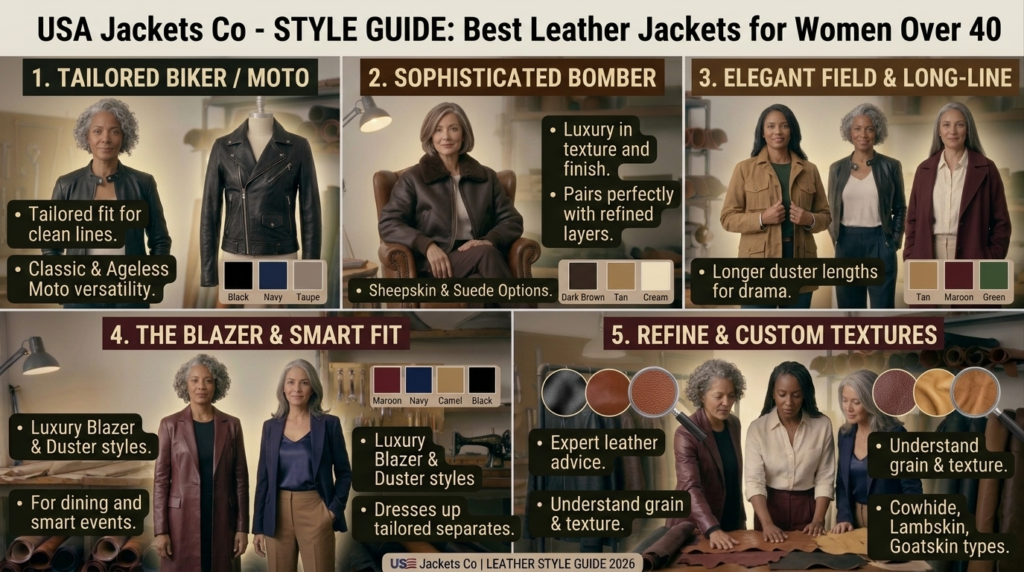
The best leather jackets for women over 40 are not defined by an age rule. They are the jackets that fit comfortably, work with the clothes you already own, and suit the way you spend your days. A clean-lined racer can feel polished, a relaxed bomber can make everyday dressing easy, and a classic biker can add definition to simple jeans and a T-shirt. The right choice depends on your taste, climate, preferred fit, and how often you expect to wear it.
This guide focuses on practical decisions rather than rules about what women should or should not wear after a certain birthday. Use the outfit ideas as starting points, then adapt the proportions and details to your own style.
What makes a leather jacket a good choice?
A versatile jacket should solve more wardrobe problems than it creates. Ideally, it works with several outfits, feels comfortable when you sit and move, and has a finish you are happy to maintain. Before choosing a design, consider three questions:
- Where will you wear it? Daily errands, commuting, dinners, weekends, and travel may call for different levels of structure and warmth.
- What do you already wear? Look at your most-used trousers, jeans, skirts, dresses, shoes, and bags. A jacket that matches those pieces will be easier to repeat.
- How much visual detail do you enjoy? Zips, snaps, belts, quilting, and large lapels make a stronger statement. A simple front and minimal hardware are easier to combine with patterned or tailored clothes.
If you are exploring silhouettes, start with the USA Jackets Co women’s leather jacket style guide and compare the shapes with the clothes you wear most often.
Best leather jacket styles for women over 40
1. The clean racer jacket
A racer usually has a streamlined front, a small collar or snap tab, and fewer decorative details than a traditional biker. That makes it a useful choice if you prefer understated outfits or want one jacket to move between casual and smart-casual settings. Wear it with straight-leg jeans, a fine knit, and loafers; or pair it with tailored trousers and a simple blouse. Black is crisp and graphic, while dark brown or cognac feels warmer.
Check that the jacket is not so narrow that the front pulls when you sit. A sleek silhouette should still allow you to reach forward, drive, and layer a thin sweater beneath it.
2. The classic biker jacket
A biker jacket brings character through its angled zip, lapels, and hardware. It can balance softer pieces such as a midi dress, a pleated skirt, or a fine-gauge knit. For a restrained look, choose a design with modest hardware and let the cut do the work. If you love a more expressive style, a belted or asymmetrical version can be the centrepiece of a simple outfit.
Because a biker jacket already has strong visual lines, keep the rest of the outfit relatively uncomplicated when you want an easy everyday result: one-colour top, straight jeans, and ankle boots are a dependable starting point.
3. The leather bomber
A bomber is often the most relaxed option. Its ribbed cuffs and hem give it a casual shape that works with denim, wide-leg trousers, T-shirts, and trainers. A compact bomber can feel neat; a roomier cut creates a more laid-back silhouette. Either can work, provided the shoulders and sleeves feel intentional rather than accidentally oversized.
When wearing a bomber with wide trousers or a full skirt, check the overall proportions in a mirror. A jacket ending near the waist creates a different effect from one that covers the hips. Neither is automatically better—the balance should feel comfortable to you.
4. The refined leather blazer
If your wardrobe includes tailored trousers, simple dresses, or office-friendly separates, a leather blazer can be a useful alternative to a heavily detailed moto jacket. Its lapels and longer lines make it feel closer to tailoring while retaining the texture of leather. Wear it with a fine knit and straight trousers, or use it to give a plain dress a little structure.
Choose a blazer that allows the lapels to lie flat when closed and does not pull across the back. If you want to wear it over a thicker knit, try it on with that layer rather than judging the fit over a thin top.
5. A longer leather coat
A longer coat is worth considering if you prefer extra coverage or want a more vertical line over trousers and dresses. It can be particularly practical in cooler weather, although its weight and length may make it less convenient for frequent travel. Look at the lining, closure, and movement around the knees and hips before buying.
How to choose the right fit
Fit matters more than the label size. Leather may soften or relax with wear, but it should not be painfully tight at the start, and it should not require you to accept restricted movement on the assumption that it will stretch.
- Shoulders: seams should sit near your natural shoulder points for a conventional fit. A dropped shoulder is fine when it is part of the intended design.
- Chest and front closure: zip or button the jacket. Look for pulling, gaping, or strong diagonal tension lines.
- Back and armholes: reach forward, hug yourself, and lift your arms. You should be able to move without the jacket cutting sharply into your upper back.
- Sleeves: check their length with your arms relaxed and slightly bent. Sleeve length can change the appearance of the whole jacket.
- Body length: try it with your usual jeans, trousers, or dresses. A hem that works with one outfit may not suit every proportion.
- Layers: test the jacket over the type of top you plan to wear most often, not just a thin T-shirt.
When buying online, compare your measurements with the garment’s size chart and check whether the listed measurements refer to the jacket itself or the body. If a product page is unclear about fit, lining, or care, ask before ordering.
Which leather and finish should you choose?
Material affects feel, structure, appearance, and care. Soft lambskin is often chosen for a supple, lightweight fashion jacket. Cowhide can feel firmer and more structured, while goatskin often has visible grain and a flexible feel. Suede offers a matte, tactile surface that looks relaxed, but it needs more attention around moisture and stains than many smooth finishes.
There is no universal winner. Consider the jacket’s construction and finish alongside the hide name. A soft leather with a heavy lining may feel warmer than a lightweight jacket made from a firmer leather. For a frequently worn piece, read the care instructions and decide whether you are comfortable following them.
Colors that are easy to wear
Black
Black is a strong option if your wardrobe includes black trousers, dark denim, white shirts, grey knits, or monochrome outfits. It gives contrast to light dresses and can make a casual outfit look more defined. If black feels severe with your usual palette, soften it with cream, pale blue, or warm accessories.
Brown, tan, and cognac
Brown works naturally with blue denim, cream, beige, olive, and other earthy shades. Dark chocolate looks more restrained; cognac and tan create a lighter, more relaxed effect. For more ideas, see the brown leather jacket outfit guide.
Color beyond neutrals
Burgundy, deep green, navy, and other colors can be excellent choices if they repeat shades already present in your wardrobe. Before choosing a statement color, identify at least three outfits you would wear it with. That simple test helps you distinguish a jacket you love in theory from one you will reach for often.
Six outfit formulas to try
- Everyday casual: racer jacket, white T-shirt, straight-leg jeans, and clean trainers.
- Polished daytime: brown leather jacket, cream knit, tailored navy or charcoal trousers, and loafers.
- Dress and jacket: a simple midi dress, cropped biker, and ankle boots. Keep the jacket hem and dress shape in balance.
- Relaxed weekend: bomber, striped top, dark denim, and comfortable flat shoes.
- Smart-casual evening: minimal black jacket, a plain blouse, wide-leg trousers, and low heels or sleek boots.
- Cool-weather layers: leather jacket over a thin merino or cotton knit, with a scarf and a coat available for genuinely cold or wet conditions.
These combinations are deliberately flexible. Change the footwear, hem length, and accessories to suit your day; there is no need to buy a new outfit around every jacket.
Common buying mistakes to avoid
- Choosing only by age-based advice. A number cannot tell you which cut, color, or amount of hardware you will enjoy.
- Buying a jacket that only works with one outfit. Try to identify several combinations before deciding.
- Ignoring shoulder and sleeve fit. These areas are noticeable and can be difficult to alter cleanly.
- Assuming leather is automatically warm or waterproof. Lining, insulation, construction, and finish make a difference. Genuine leather alone does not make a jacket waterproof.
- Overlooking care requirements. Suede and some delicate finishes need more careful handling. Follow the maker’s guidance rather than washing leather like ordinary clothing.
- Buying a size that depends on painful stretching. A jacket should feel secure but wearable from the beginning.
A practical checklist before you buy
Before ordering, confirm the jacket’s measurements, closure, lining, pocket placement, material description, care instructions, and return or exchange terms. Consider the weather where you live and whether you will wear the jacket over a T-shirt, blouse, or knit. If you are between sizes, use the garment measurements and ask the seller how the cut is intended to fit rather than guessing from the number on the label.
You can browse the women’s casual leather jacket collection for different silhouettes and colors, then compare each product’s details against this checklist.
Frequently asked questions
Can women over 40 wear a biker jacket?
Yes. A biker jacket can be styled at any age. Choose the amount of hardware, fit, and color that feels right to you, then balance the jacket with simple pieces if you prefer a less dramatic outfit.
Which leather jacket style is the most versatile?
A clean racer or understated bomber is often easy to combine with many casual outfits. A classic biker can be just as versatile if its details fit your personal style. Your existing wardrobe is the best guide.
Is black or brown better for everyday wear?
Neither is universally better. Black pairs naturally with monochrome clothing and darker footwear; brown works especially well with denim, cream, beige, and olive. Choose the shade that matches the clothes you wear most.
Should a leather jacket feel tight at first?
It should fit close enough to look intentional but allow normal movement and comfortable breathing. Do not buy a jacket that pulls painfully or prevents you from reaching forward on the assumption that it will stretch enough later.
Can I wear a leather jacket to work or a dinner?
In many smart-casual settings, a simple racer or leather blazer can work well with tailored trousers, a blouse, or a plain dress. Follow your workplace’s dress expectations and choose a design with a level of detail that suits the occasion.
Final thought
The best leather jacket for a woman over 40 is one that feels like you: comfortable in motion, easy to combine with your clothes, and appropriate for the occasions you actually have. Start with fit and repeatable outfits, then choose the silhouette and finish that make you want to wear it. Style does not need an age limit; it needs a thoughtful fit and a wardrobe that works for your life.
