
How to Choose Between a Biker, Bomber, Racer and Aviator Jacket
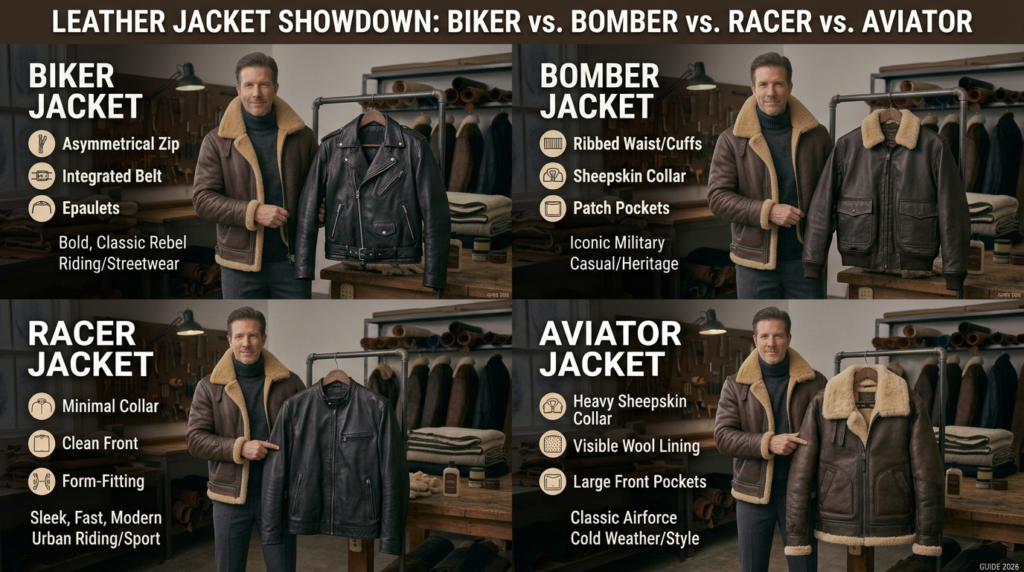
Choosing between a biker, bomber, racer and aviator jacket is easier when you compare the shape, details and way you will wear it—not just the name on the product page. A biker jacket makes a stronger statement, a bomber is relaxed and easy to style, a racer looks clean and streamlined, and an aviator usually brings a more substantial, heritage-inspired feel.
There is no single best style for everyone. Use this guide to identify the silhouette that fits your wardrobe, climate and routine, then check the garment’s measurements and construction before buying.
At a glance: which leather jacket style suits you?
| Style | Common design details | Best suited to | Consider before buying |
|---|---|---|---|
| Biker | Often an offset zip, wide lapels, snaps, belt or visible hardware | Bold casual outfits and motorcycle-inspired fashion | Hardware and lapels can make it feel more statement-led |
| Bomber | Usually a central zip, short body and ribbed or elasticated cuffs and hem | Everyday wear, denim, chinos and relaxed layering | Check the hem length and how much volume the cut adds |
| Racer / café racer | Often a straight zip, small stand collar and minimal decoration | Clean, understated outfits and smart-casual combinations | A slim cut can limit layering if you choose the wrong size |
| Aviator / flight | May have a generous collar, warm lining, shearling-style trim or buckles | Heritage styling and cooler-weather outfits | Insulation can add weight and bulk; check the actual lining |
These labels are not perfectly standardized. One retailer may use “racer” and “café racer” interchangeably, while another may classify a flight-inspired design as a bomber. Treat the name as a starting point and judge the actual cut, materials and details.
1. Biker jacket: choose it for a stronger, more defined look
A classic fashion biker jacket is often recognized by its diagonal front zip, broad lapels, snap fasteners and sometimes a waist belt or decorative zips. The asymmetrical front gives it a distinctive outline, even when the rest of the outfit is simple.
When a biker jacket makes sense
- You like outfits built around jeans, boots, plain T-shirts or dark knitwear.
- You want the jacket itself to be a visible part of the outfit rather than a quiet layer.
- You enjoy vintage, rock-inspired or rugged styling.
- You prefer a structured shape with more visible details than a minimal racer.
For an easy everyday combination, wear a black biker jacket with straight-leg denim, a neutral T-shirt and simple boots or sneakers. Brown versions work well with cream, navy, olive and faded blue denim. If the jacket has several zips, buckles or quilted panels, keep the rest of the outfit relatively uncomplicated so the details do not compete.
What to check
Close the jacket fully and make sure the lapels sit comfortably rather than pressing into your neck. Check that the diagonal zip does not pull across the chest, and try reaching forward and sitting down. A belt or multiple metal details may look appealing in a photo but should not dig into you or catch on other clothing.
Important: “Biker” can describe a fashion silhouette, not a safety rating. If you intend to ride a motorcycle, verify that the exact garment is designed and documented as protective riding equipment. Do not assume that a leather fashion jacket has tested abrasion resistance, impact armour or reinforced seams.
2. Bomber jacket: choose it for everyday versatility
A bomber generally has a central front closure, a shorter body and ribbed or elasticated cuffs and hem. The shape can be neat or deliberately relaxed, but it usually feels less angular than a traditional biker jacket. Leather and suede versions give this familiar casual silhouette a more substantial texture.
When a bomber jacket makes sense
- You want one jacket that works with T-shirts, sweatshirts, knitwear and casual shirts.
- Your usual outfits include denim, chinos, relaxed trousers or clean sneakers.
- You prefer a straightforward front without prominent lapels and hardware.
- You like a casual shape that can work across several seasons, depending on its lining.
A black or dark brown bomber is a useful starting point for a wardrobe built around neutral basics. Try it with a white tee and blue jeans for a simple weekend outfit, or wear a fine-gauge knit and chinos for a more considered casual look. A suede bomber creates a softer, less glossy finish than smooth leather.
What to check
The hem is central to a bomber’s shape. It should sit where the design intends without riding up excessively when you raise your arms. Ribbed cuffs should feel secure but not tight. If you prefer a streamlined appearance, avoid a cut that is so oversized that the shoulders and sleeves overwhelm the rest of your outfit. If you want room for a hoodie, try the jacket over one before choosing a size.
If you are interested in adapting the silhouette, explore USA Jackets Co’s custom bomber jackets page for design ideas and details to discuss, such as colour, lining and finishing options.
3. Racer jacket: choose it for a clean, minimal silhouette
A racer jacket—often called a café racer—typically has a straight front zip, a small stand collar and limited decoration. Some designs include a small collar snap, subtle shoulder panels or discreet pockets, but the overall effect is usually simpler than a biker jacket.
When a racer jacket makes sense
- You prefer a neat, understated look over a heavily detailed jacket.
- You want a leather layer that pairs with jeans as easily as it does with chinos.
- Your wardrobe includes plain tees, Oxford shirts, fine knitwear and simple footwear.
- You want the jacket to add texture without dominating the outfit.
For everyday wear, a dark racer can sit comfortably between casual and smart-casual styling. Combine it with a crew-neck knit, dark jeans and clean shoes, or use it over a casual button-down with chinos. The minimal design also makes colour easier to work with: black looks sharp and graphic, while brown or tan can feel warmer and more relaxed.
What to check
Minimal jackets leave fewer decorative details to distract from fit, so pay close attention to the shoulders, chest and sleeve length. A racer may look sleek when worn close to the body, but it should not pull when you reach forward or zip it over your usual base layer. If you regularly wear thick sweaters, make sure the cut allows that extra room.
Do not confuse a racer-inspired fashion jacket with certified motorcycle gear. The appearance alone does not tell you whether the garment includes suitable armour or has been tested for riding.
4. Aviator jacket: choose it for heritage character and colder-weather layering
Aviator or flight jackets draw on pilot outerwear. Depending on the design, they may have a generous collar, a warm lining, buckle details, a substantial body or shearling-style trim. Some are lightweight and streamlined; others are bulky winter pieces. The word “aviator” alone does not guarantee a particular level of insulation.
When an aviator jacket makes sense
- You want a heritage-inspired look with more visual texture and volume.
- You often wear knitwear, denim, boots and earthy colours.
- You need a winter layer and the specific jacket has suitable insulation and coverage.
- You prefer a prominent collar or a more substantial silhouette.
For a balanced outfit, let the aviator be the main feature. Wear it with straight-leg jeans, a plain knit and simple boots. If the collar or lining is bulky, choose trousers with a clean shape rather than adding volume everywhere. Brown leather with cream, charcoal, navy or olive can create a classic palette without needing matching accessories.
What to check
Look beyond the exterior. Check the lining composition, insulation, weight, collar fastening and how comfortably the jacket closes over the layers you will actually wear. A thick-looking jacket may not be warm enough for your climate if the lining is light, while a heavily insulated one may feel cumbersome indoors or during travel. Confirm care instructions too, especially if the jacket uses shearling, suede or mixed materials.
How to make the choice: five practical questions
1. What do you wear most days?
Look at your existing wardrobe before buying. If you live in denim and sneakers, a bomber is an easy fit. If you often wear dark jeans and boots, a biker may feel natural. If you favour shirts, chinos and understated shoes, a racer can bridge casual and smart-casual outfits. If your wardrobe already includes heavy knits and winter boots, an aviator may earn its place.
2. Do you want the jacket to stand out or blend in?
A biker usually makes a stronger visual statement because of its lapels and asymmetrical closure. A racer tends to be quieter. A bomber sits between the two depending on its panels and hardware, while an aviator often stands out through its collar, lining and volume. Pick the level of detail you will still enjoy after the novelty wears off.
3. What weather will you wear it in?
Warmth depends on the lining, insulation, coverage, wind exposure and fit—not just the style name or the fact that the shell is leather. A light racer can be suitable for mild conditions, while a lined aviator may work better in colder weather. For rain, check the manufacturer’s guidance; leather should not automatically be treated as waterproof.
4. How much room do you need for layers?
Try the jacket over the thickest layer you realistically expect to wear. A close-fitting racer may be ideal over a T-shirt but uncomfortable over a heavy knit if the size is too small. A bomber may offer more room, though cuts vary. Aviators can accommodate layers but may already have substantial insulation.
5. Is this for fashion or actual motorcycle riding?
This question changes the buying checklist. For fashion, focus on silhouette, fit, materials, comfort and how the jacket works with your wardrobe. For riding, verify the exact garment’s intended use, protective rating where applicable, armour, seams and fit in riding position. The UK government’s motorcycle safety equipment guidance notes that specialised motorcycle gear is highly recommended. Check the rules and standards relevant to your country and the manufacturer’s documentation before relying on any garment for protection.
Fit checklist for all four styles
- Shoulders: seams should sit close to the intended shoulder point without obvious sagging or pinching.
- Chest: the jacket should close without strong horizontal pulling or excessive empty space.
- Sleeves: check length with your arms relaxed and while reaching forward.
- Body length: confirm the hem works with your proportions and the trousers you wear most.
- Movement: sit down, raise your arms and reach forward before deciding.
- Layering: use the size chart and garment measurements instead of guessing from your usual letter size.
Leather may soften and relax with wear, but it should not be expected to transform a badly fitting jacket into the right size. For more detailed checks, read our leather jacket buying guide.
Quick outfit formulas
| Style | Simple outfit formula | Keep in mind |
|---|---|---|
| Biker | Plain tee + straight jeans + boots | Let the jacket’s hardware provide the detail. |
| Bomber | Fine knit or sweatshirt + chinos + sneakers | Balance a roomy jacket with cleaner lines below. |
| Racer | Oxford shirt or crew-neck knit + dark denim | Keep colours and accessories restrained for a minimal look. |
| Aviator | Neutral knit + straight jeans + sturdy boots | Keep the other layers simple if the collar is large. |
These are starting points rather than rules. Change the footwear, proportions and colours to suit your climate and personal style. For a broader overview of silhouettes, see our guide to types of leather jackets and our advice on choosing a first leather jacket. You can also browse the men’s collection to compare the styles currently available.
Frequently asked questions
Which is the most versatile: biker, bomber, racer or aviator?
For many everyday wardrobes, a simple bomber or racer is easy to combine with different outfits. A plain biker can also be versatile if you like its stronger details. An aviator is a good choice when its weight, lining and silhouette suit your climate and wardrobe.
Is a racer jacket the same as a café racer?
The terms are often used for similar streamlined jackets with a straight zip and a small collar. Retailers do not always use the names consistently, so compare the actual design and measurements.
Which style is warmest?
The aviator is often sold in warmer, more insulated versions, but the style name is not enough to judge warmth. Check the lining, insulation, coverage and manufacturer’s product details.
Can I wear a biker jacket with smart-casual clothes?
Yes. Choose a cleaner design with restrained hardware and combine it with a plain knit, dark jeans or chinos and simple shoes. A minimal racer may be an easier option if you prefer a quieter appearance.
Can I use a fashion biker jacket for motorcycle riding?
Do not assume it is protective because it looks like riding gear or is made of leather. Check whether the exact garment is intended and documented for motorcycle use, including relevant protective construction and armour.
What should I buy as my first leather jacket?
Start with the outfits you already wear. A bomber is a practical option for relaxed casual dressing, a racer for minimal styling, a biker for a stronger look, and an aviator if you want a substantial heritage style and need its specific level of warmth.
Final recommendation
Choose the jacket you can picture wearing repeatedly, not simply the one that looks best in a single photograph. Bikers bring edge, bombers offer relaxed versatility, racers keep the look clean, and aviators add heritage character and can provide extra warmth when properly lined. Compare the exact cut, measurements, materials, lining and care instructions before ordering—and if you plan to ride, verify protective performance separately from appearance.
