
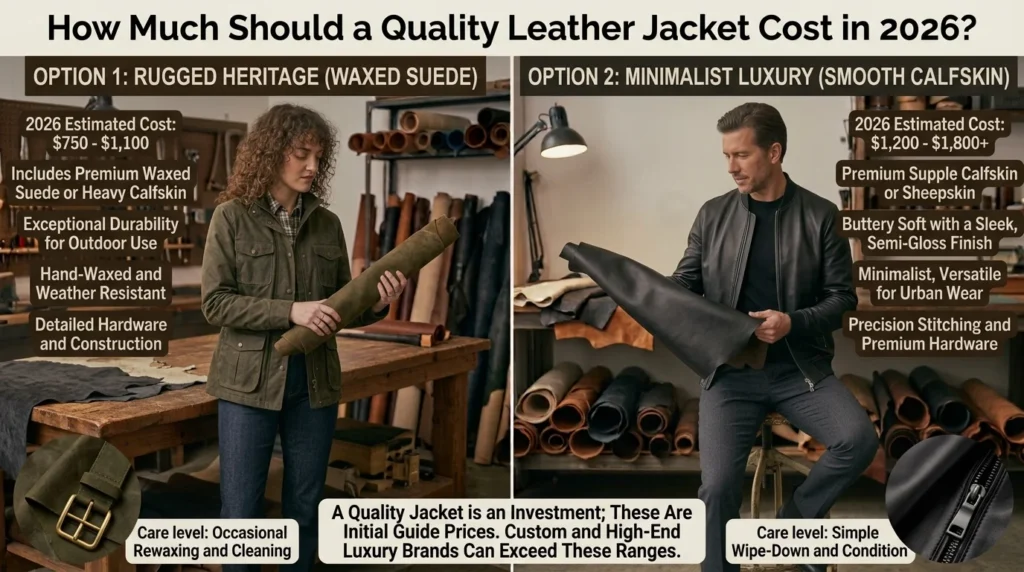
Leather jackets are sold across a very wide price range. You can find styles under $100, everyday genuine-leather jackets around a few hundred dollars, and luxury or highly specialized pieces that cost far more. That makes one question difficult for many shoppers: how much should a quality leather jacket cost in 2026?
The short answer is that price should reflect more than the word “leather.” The hide, leather grade, tanning, thickness, lining, hardware, construction, fit, finishing and brand position all affect the final cost. A higher price can be justified, but an expensive jacket is not automatically a better jacket.
This guide gives you a practical way to judge value, understand common price bands and avoid paying for marketing instead of quality.
Leather Jacket Price Ranges in 2026
| Typical price | What you may find | What to check carefully |
|---|---|---|
| Under $100 | Faux leather, thin split leather, basic fashion pieces | Material accuracy, peeling risk, stitching and lining |
| $100–$250 | Entry-level genuine leather and sale-priced fashion jackets | Leather thickness, finish, hardware and sizing |
| $250–$500 | Better everyday leather jackets with stronger construction and more design choice | Whether the materials and workmanship support the premium |
| $500–$1,000 | Specialist, heritage, premium or made-to-measure pieces | Leather origin, construction details, fit service and aftercare |
| $1,000+ | Luxury branding, rare materials, designer work or highly detailed custom pieces | How much is craftsmanship versus brand or exclusivity |
These are broad guide ranges rather than fixed rules. Sales, country, import costs, customization and seasonal demand can change the price of a particular jacket.
What Actually Determines the Price?
1. Leather type and grade
Full-grain leather generally keeps more of the hide’s natural surface, while top-grain leather is usually corrected or refined to create a more uniform appearance. Split leather and suede can also be useful materials, but they have different textures, finishes and performance characteristics.
Leather grade matters, but it should not be considered alone. A well-made top-grain jacket may offer better consistency and styling than a poorly constructed full-grain jacket.
2. Hide selection and cutting
Better manufacturers spend more time selecting hides with consistent thickness, attractive grain and fewer serious defects. Pattern placement also matters. Efficient cutting can reduce waste, but careless cutting can create uneven panels or awkward grain direction.
3. Tanning and finishing
Tanning converts hide into a stable wearable material. The process influences softness, color, surface character and how the leather develops over time. Finishing may add a smooth, matte, distressed or polished appearance.
A heavily finished leather can look very uniform, while a more natural finish may show variation. Neither is automatically superior; the right choice depends on the look and use you want.
4. Construction and stitching
Construction includes panel joining, seam strength, edge finishing, collar attachment, pocket installation and the way the lining is connected. A jacket that looks attractive in a product photo can still feel disappointing if the seams pucker or the panels sit unevenly.
5. Hardware
Zippers, snaps, buckles and adjusters affect both appearance and daily use. Hardware should operate smoothly and be appropriate for the weight of the leather. A premium price should not be used to excuse weak or poorly aligned hardware.
6. Lining and comfort
The lining affects how easily the jacket goes on, how it layers over clothing and how comfortable it feels during extended wear. Lightweight viscose, polyester and quilted linings each create a different balance of smoothness, warmth and structure.
7. Fit and pattern development
A jacket with a carefully developed pattern can look much better than a cheaper jacket made from a generic block, even when the leather itself appears similar. Shoulder angle, sleeve shape, armhole position, body length and room for layering all affect the final fit.
Is a $150 Leather Jacket Good Quality?
It can be. Around this level, you may find genuine leather jackets, especially during promotions or from direct-to-consumer sellers. The important question is not whether the price is low or high, but what the jacket actually offers.
At this price, inspect:
- Whether the description clearly identifies genuine leather rather than vague “leather look” wording.
- Whether the leather is thin, heavily coated or inconsistent.
- Whether the zipper and pocket openings are aligned.
- Whether the lining is attached cleanly.
- Whether measurements are provided rather than only generic size labels.
- Whether returns and exchanges are explained clearly.
A sale price can make a good jacket accessible, but a discount should not replace basic product information.
Is $300–$500 the Sweet Spot?
For many shoppers, the $300–$500 range can be a practical middle ground. It often includes more choice in leather type, cleaner construction, better hardware and more distinctive designs without moving fully into luxury pricing.
This range may also include jackets with more specialized details, custom color options, made-to-measure services or better finishing. For example, USA Jackets Co product pages currently show everyday leather styles in the low-to-mid hundreds, including sale-priced options around $199–$249 and regular prices near $279–$399. Those examples illustrate why it is useful to compare the material, features and shipping information rather than judging from the price alone. citeturn476091search0turn476091search2turn476091search3
Why Do Some Leather Jackets Cost Over $1,000?
Very high prices can come from several different sources:
- Luxury brand positioning and retail markups.
- Rare or unusually expensive materials.
- Small-batch production and low volume.
- Hand-finishing or specialist construction.
- Complex embroidery, artwork or hardware.
- Made-to-measure development and fittings.
- Designer exclusivity and limited availability.
Some high-priced jackets genuinely involve exceptional materials or craftsmanship. Others mainly charge for brand recognition. If you are buying for daily wear, compare the actual construction and usability with less expensive alternatives before assuming the most expensive option is the best value.
How to Judge Whether a Jacket Is Worth Its Price
Read the material description carefully
Look for a specific statement about the shell material, such as lamb leather, cowhide, suede or top-grain leather. Be cautious when the product uses only broad phrases such as “premium leather” without further detail.
Look for construction evidence
Product images should help you inspect the collar, cuffs, seams, zipper, pockets and lining. Close-up photographs are more useful than a single heavily edited lifestyle image.
Compare measurements, not just sizes
A medium is not the same across every brand. Compare chest, shoulder, sleeve and body measurements with a jacket you already own that fits well.
Consider the cost per wear
A $250 jacket worn twice a week for several years may deliver better value than a $100 jacket worn only a few times because it feels uncomfortable or does not work with your wardrobe.
Check aftercare and service
Clear care instructions, shipping information, exchange terms and customer support are part of the buying experience. They do not replace material quality, but they reduce uncertainty.
Should You Buy Real Leather or Faux Leather?
Faux leather can be a reasonable option when a lower price, lighter weight or animal-free material is the priority. It can also make sense if you want a trend-focused jacket that you do not expect to keep for many years.
Real leather is often chosen for its natural texture, ability to develop character and long-term repair potential. However, real leather still varies widely. Buying genuine leather does not guarantee perfect quality, so construction and fit remain essential.
Does Made-to-Measure Always Cost More?
Made-to-measure work often costs more because it involves additional communication, pattern adjustments and production handling. It can be worthwhile when standard sizing does not suit your proportions or when you want a specific color, finish or design detail.
It is not automatically better for everyone. If a ready-to-wear jacket already fits well and meets your needs, made-to-measure may add cost without enough practical benefit.
Red Flags That Suggest You Are Overpaying
- The product claims “premium” quality but does not identify the leather type.
- The price is high while the photos hide seams, hardware and lining.
- The description focuses on celebrity or trend language instead of construction.
- There are no usable measurements or fit notes.
- The jacket has unusually expensive branding but ordinary materials and workmanship.
- Important shipping, return or care information is missing.
Red Flags That Suggest a Bargain May Be Too Good to Be True
- The material is described inconsistently across the page.
- The product photos appear to show different jackets.
- The listing uses “genuine leather” but gives no shell composition or thickness information.
- The stitching, zipper and lining are not shown clearly.
- The price is dramatically below comparable genuine-leather products without a clear reason.
A Practical Budget by Buyer Type
First leather jacket
Budgeting roughly $150–$300 can give you access to a useful genuine-leather everyday jacket while leaving room to compare styles and fit.
Long-term wardrobe staple
A budget of around $250–$500 may offer a better balance of construction, material choice and versatility, especially if you expect to wear the jacket regularly.
Custom or specialist jacket
For made-to-measure sizing, complex artwork, unusual materials or highly detailed designs, expect the price to move higher. Compare the extra service and craftsmanship with your actual needs.
Frequently Asked Questions
What is a reasonable price for a real leather jacket?
For many buyers, a genuine leather jacket between about $150 and $500 can offer a practical balance of material, construction and design. The right price depends on the specific leather, workmanship and fit.
Are expensive leather jackets always better?
No. A high price may reflect luxury branding, exclusivity or complex design rather than better everyday construction. Compare materials, stitching, hardware, lining and fit.
Is a $100 leather jacket worth buying?
Sometimes, especially during a sale, but inspect the material description and construction carefully. At the lower end, you are more likely to encounter thin leather, split leather or faux leather.
What is the best leather jacket price for everyday wear?
A well-fitting jacket around the $200–$500 range is often a sensible target for everyday use, provided the materials and workmanship support the price.
Does leather quality matter more than brand name?
For practical value, yes. Brand reputation can help with consistency and service, but the jacket should still be judged by its leather, construction, fit and intended use.
Final Takeaway
A quality leather jacket in 2026 does not have one universal price. A useful starting point is to think in bands: under $100 for budget or faux-leather options, $100–$250 for entry-level genuine leather and sale pieces, $250–$500 for many strong everyday choices, and higher prices for specialist, luxury or custom work.
Before you pay, ask what you are actually buying: what leather is used, how the jacket is constructed, how it fits, how often you will wear it and what support comes with the purchase. The best value is not the cheapest jacket or the most expensive one. It is the jacket whose quality and usefulness match the money you spend.
